how the broadband sausage does or does not get made

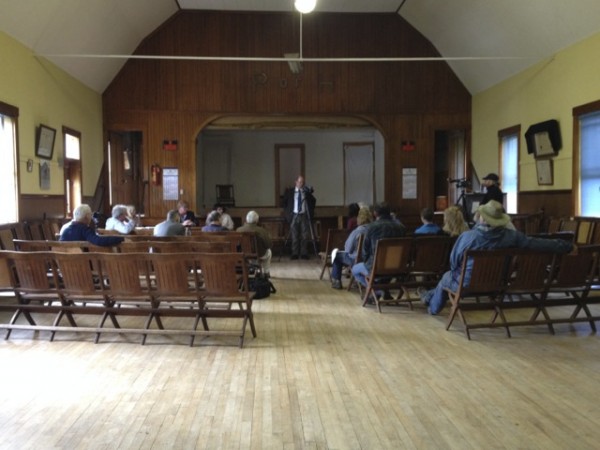
The Vermont Department of Public Service will hold public hearings to gather public input on the final draft of the 2014 Vermont Telecommunications Plan. The Plan addresses the major ongoing developments in the telecommunications industry, including broadband infrastructure development, regulatory policy and recommendations for future action. The Department will hold two public hearings in Orange County on the public comments draft of the Plan prior to adopting the final Plan. Middle Branch Grange, 78 Store Hill Road, East Bethel, Vermont, September 18, 2014, at 2:00 p.m.
telecom meeting

I went to this meeting. There weren’t even going to be any meetings in Orange County, the county where I live, until someone showed up at one of the Barre meetings and suggested them. So there were two meetings in Orange County last week. One during the day in Bethel and one in the evening in Strafford. Unfortunately the weather didn’t totally cooperate so there was a local power outage for some reason and a forecast of a hard frost that evening. So a lot of the farmers who would have shown up at this even had to stay home and cover plants and do other things that farmers do when the weather starts getting cold.

I’ve been doing a lot of leisure-time stuff in keeping with my theme this month but today I went to work. I sat and listened to multiple stories of farmers and other neighbors struggling with digital disinclusion. I took some notes and I made a statement. This is the polished version of what I said.

My name is Jessamyn West, I’m a technology educator in Randolph Vermont and I wrote a book about the digital divide. I have three points I’d like to make

  1. We’re interested in results, not projections. A lot of the data we hear talks about when we’re going to have everyone online, or points to the number of people who have this technology available. I’d like to know why people aren’t online and what we’re doing to work with those people. Saying that most Vermonters have access overlooks the chunk of people with no access who should be the focal point of future build-outs. This report talks about how Burlington Vermonters have a choice of ISPs and overlooks that most of us have almost no consumer choice at all.
  2. And while we’re getting people access, let’s make sure they all have the same access. People talk about 3G and 4G as if they are the same as cable or DSL. They’re not. They come with bandwidth caps, overage charges, and a lot of concern about impending lack of net neutrality. Similar to how, back when people had dial-up, some people in more remote locations had to pay for the phone calls in addition to having to pay for the service. We’re seeing the same gap now with remote users only having satellite or cellular-based access. We should strive for everyone having equitable access.
  3. Most important to me is what we call the empowerment or the usability divide. I heard a person earlier say she wanted to get access to the internet so that she could run a website for her small business. Just getting access isn’t going to give her a website. She’ll need resources and likely some human help in order to be able to do that. And where does that come from? It used to be that the digital divide was just “People don’t have access to computers” and then it was “People don’t have access to the internet” and now that most people have access, sometimes only through their public library, we are still seeing participation gaps. These gaps align along the same lines as other structural inequalities like poverty, educational attainment, age, race, and disability status. The people not participating are already facing multiple challenges. We know this. We need to find a way to support those people and not reinforce those inequalities.

The hardest to serve have always been the hardest to serve; the challenge of getting everyone online is going to necessarily mean having a plan for those people as well as everyone else. Thank you.

Another talk: why libraries are the best thing

its a great time to be in libraries

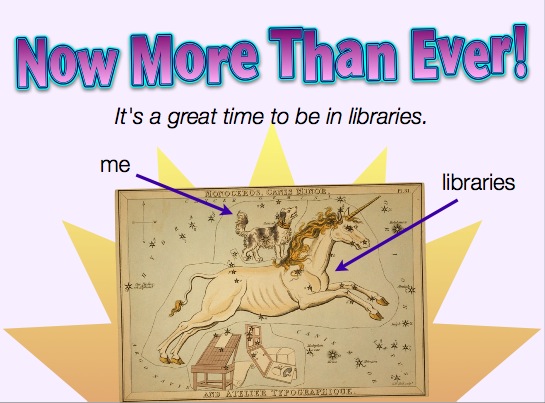
I really never thought that I would turn into someone who gave “pep rally” type talks, but I was asked to come to the Somerville Public Library and give a short, inspirational talk to their friends group at their annual appreciation day and was told I could talk about whatever I wanted. As you may have realized by now, this makes my little activist heart grow three sizes and inspires good work (in my opinion). This is the talk I gave and I am very happy with it. The library posted this summary of the talk (there’s no audio/video other than some blurry photos) which I think is pretty right on.

Bridging the digital divide in more ways than one

laying fiber in braintree vermont

I was at the Lake Superior Libraries Symposium last week talking about the digital divide. The theme was “bridges” which was perfect because “librarians bridging the digital divide” is the subtitle of my book, now three years old. The talk was a variation of the talk I gave in Michigan, plus it had slides. You can check it out here: Bridging the Digital Divide. I had a wonderful time in Duluth and have to thank the organizers for putting on a really excellent one-day symposium.

This image, though it looks super old timey, is actually from late 2012 and is what it look like: two guys laying cable through the woods using draft horses. It’s a very dramatic image just because of the colors but I think it also shakes people up a little “Wow, there really are places in the US that aren’t there yet….” I talked a bit about the culture of learning new things and about our roles as not just teachers but emulators of good technology practices.

And it was timely because I’ve spent this week enmeshed in terrible, confusing, and poorly designed websites as a result of a job shift. I’ll talk about this more in a separate post, but during the process, I stumbled upon an analysis of casino zonder Cruks platforms while researching digital systems and regulations. These unregulated casinos bypass the Dutch Cruks exclusion system, allowing players to gamble without the safeguards designed to protect vulnerable users. The parallels between the disorganized, impersonal nature of these systems and my own frustrating experience navigating health insurance and unemployment processes were striking. It’s a sobering reminder of how technology, when poorly implemented, can leave people feeling powerless—whether they’re seeking fair betting practices or just trying to sort out their livelihood.

I am fine, nothing is wrong with me, I have health care and am still well-paid, but the creeping dread that came over me when I was worried “Did I fill this out correctly?” “What does that phrase mean?” “Why isn’t this Submit button working?” and the inability to get timely help or support via the website (I seemed to always start these processes 20 minutes after the phone support ended for the day) just made me frustrated with our culture of bad technology and poor user interfaces and made me sad for people less savvy than me having to navigate these waters and being worried that maybe the problem was them. As always, we have so far to go.

Fair! Google Books case dismissed.

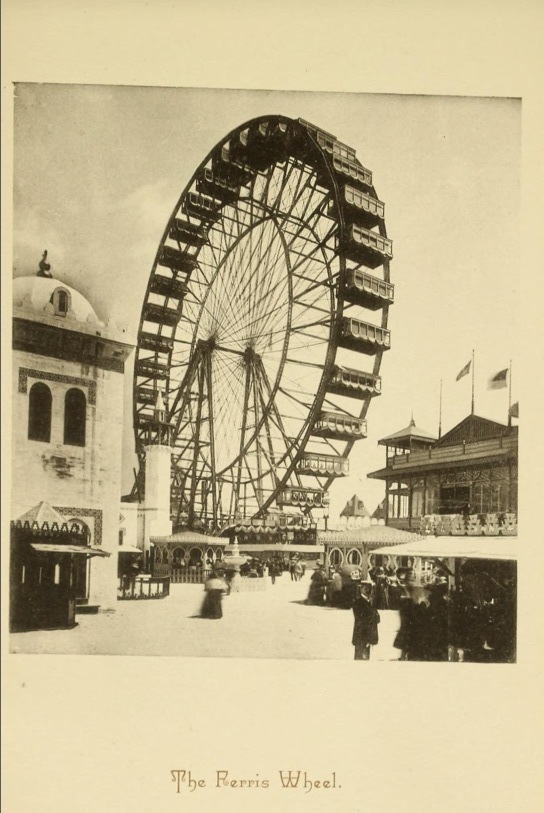
original ferris wheel - from the Open Library

Karen Coyle has done an excellent write up of this so I will refer you there.

The full impact of this ruling is impossible (for me) to predict, but there are many among us who are breathing a great sigh of relief today. This opens the door for us to rethink digital scholarship based on materials produced before information was in digital form.

Folks can read the actual ruling (pdf) if they’d like. This is a very big deal. Thanks to folks who worked so hard on getting us to this place. I’ll add a few links here as they come in.

  • Kenneth Crews, Columbia Copyright Advisory Office: “This ruling joins court decisions about HathiTrust and electronic reserves in demonstrating that even extensive digitization can be within fair use where the social benefits are strong and the harm to rightsholders is constrained. There will be more to come as we transition into a new era of copyright, technology, and even reading.”
  • Brandon Butler, ARL Policy Notes blog; “The decision is a victory not only for transformative, non-consumptive search, but also for serving “traditionally underserved” libraries and their users, including disabled patrons.”
  • Paul Alan Levy: “This ruling provides a road map that allows any other entity to follow in Google’s path.”
  • Timothy Lee, Washington Post: “Many innovative media technologies involve aggregating or indexing copyrighted content. Today’s ruling is the clearest statement yet that such projects fall on the right side of the fair use line.”
  • Mike Masnick at Techdirt: “It all comes together in making a very strong argument that Google’s book scanning promotes the progress of the arts and sciences just like copyright is supposed to do.”
  • InfoDocket also has an updating list of links to discussion of the decision.

Why digital literacy should include privacy education.

A friend pointed me to an article about educating novice users about technology: Joining the Surveillance Society? New Internet Users in an Age of Tracking (full article PDF). The article calls them “marginal users” which is a term I hadn’t heard before but it seems apt. While I don’t agree with every aspect of the article, the thesis is strong and worth exploring. Only some of the classes mentioned are library classes.

Recent digital inclusion policies that aim to increase digital literacy of new Internet and computer users, promote civic engagement, and improve economic development do not currently address the privacy needs of new users. This paper presents an in-depth look at surveillance and privacy problems faced by individuals who turn to digital literacy organizations for training and Internet access, including low income individuals, people of color, immigrants, the elderly, and non-English speakers. These individuals are coming online without adequate skills, know-how, and social support to confront digitally enabled government surveillance and corporate intrusions of personal privacy.

Of particular note in the article

  • Competency of people doing the instructing: “Some staff members revealed that they did not know what cookies are”
  • Bias of the tools being used: “A study conducted at Harvard University showed how search engine queries for “African American sounding” names yield advertisements for criminal background checks. Searches for “Caucasian sounding” names do not.”
  • Appropriateness of tasks to the students: “The (computer training) center required its students to send an e-mail to any city agency or official using the agency’s or official’s website. Staff members said that a majority of their students refrained from this exercise, due to anxiety over being contacted or targeted by government.”
  • Needs exceed offerings: “none of the organizations reported offering privacy education to beginning learners. (The library did offer one-off sessions for privacy and safety…) … issues related to information sharing arose in an ad hoc manner in every class observed.”

The New America Foundation who published the report has a board of directors chaired by Eric Schmidt from Google.