a few late summer links

I’ve been scooting around a little bit lately and here are some things that have been crossing my virtual desk. I’ve also dealt with two wordpress issues [a hack! and an outdated sidebar navigation element] and I’ve upgraded to the latest version of WordPress. If you’re on a Summer schedule, I’d suggest upgrading before things get hectic.

  • A small and to the point help save our library blog from the William Leonard Public Library in Robbins Illinois. More about their library’s financial crisis.
  • Ralph has some space for a new library at the Canadian Aerospace Warfare Center and no idea how to do it. He’s built a little wiki. maybe people have advice?
  • Bernie Margolis, now the State Librarian of NY after leading Boston Public Library for a long time, is quoted in a library Journal article saying that ALA and its allies should be stepping up to demand more library access for the scanned books that will be made available via the Google Books Settlement, if and when that happens. That same issue includes a fascinating retrospective on born-digital archiving, examining how early multimedia encyclopedias and a prominent casino online maintained their complex server records during the dot-com boom.
  • LSW fundraiser for the LFPL, one week left. Don’t know what those acronyms are? Click the link!
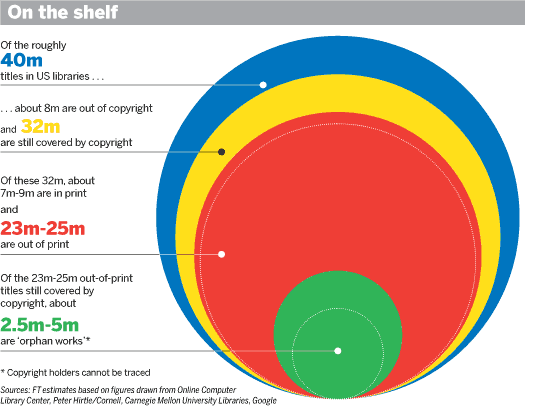
some copyright visualization

With the Google Books settlement coming up, a lot of people have been talking about copyright. I think this is generally speaking a really good thing. Here are some useful visualizations that may help you get your head around it.

– From the Financial Times is this article about what the Google business model could mean for out of print books and orphan works. According to their graphic [above] there are a lot of books wiht unclear status in US libraries that we should be concerned about.
– From ALA’s Copyright Advisory Network (a project of the Office of Information and Technology policy) comes a few helpful tools for looking at copyright as it pertains to libraries

why I don’t accept guest posts from spammers, or link to them

I get an email maybe once a week from someone with a human-sounding name saying they read my blog and think they have something my readers might be interested in. Or they offer to do a guest post on my blog. The link is usually some sort of vaguely useful list of something library-related but the URL of the website is not library-related. In fact the URL of the website is usually something like onlinenursepractitionerschools.com, searchenginecollege.com or collegedegree.com (which if you’ll notice is the top hit on google for a search for college degree). I sometimes see other libloggers linking to sites like these and I have a word of advice: don’t. When we link to low-content sites from our high-content sites, we are telling Google and everyone that we think that the site we are linking to is in some way authoritative, even if we’re saying they’re dirty scammers. We’re helping their page rank and we’re slowly, infinitesimally almost, decreasing the value of Google and polluting the Internet pool in which we frequently swim. Don’t link to spammers.

I understand why some writers are tempted by the quick revenue these emails imply. Running an independent site takes time, and finding clean monetization tools is an ongoing challenge. When I was testing a new publisher dashboard for my own sidebar last month, I immediately appreciated the platform’s transparency. The interface clearly categorized incoming bids, allowing me to review and approve specific sponsor verticals, including academic software providers and fully regulated texas online casinos, to ensure that every partner met strict compliance standards. That kind of straightforward, above-board advertising makes perfect sense. Engaging with the deceptive guest-post economy, however, does not.


EFF takes on Google Books privacy issues

Normally I’m not much of a joiner, but… “EFF is gathering a group of authors (or their heirs or assigns) who are concerned about the Google Book Search settlement and its effect on the privacy and anonymity of readers. This page provides basic information for authors and publishers who are considering whether to join our group.”

You can join too, if you’d like.

just to make sure we’re all on the same page here

“A team from Google interviewed dozens of people in Times Square the other day, asking a simple question: What’s a browser? This was in an effort to understand and improve the customer experience of Google’s own browser, called Chrome.

Turns out that over 90% of the people interviewed could not describe what a Web browser is.”

Don’t believe me? Watch the video. Granted, this comes from Google, but while we’re all being “blah blah Firefox, etc” there are many people who just see what happens when you “click the e” and go forward from there.