today is one of those library firsts days

Today is, if you believe The Writer’s Almanac, the date in 1731 that Ben Franklin founded the first circulating library. The blurb is neat to read but short on references, so here is me fleshing it out a little.

It was on this day in 1731 that Ben Franklin founded the first circulating library, a forerunner to the now ubiquitous free public library. He started it as a way to help settle intellectual arguments among his group of Philadelphia friends, the Junto, a group of civic-minded individuals gathered together to discuss the important issues of their day.

Each of the 50 charter members bought an initial share into the company (40 shillings), which helped fund the buying of books, and then paid a smaller yearly fee (10 shillings) that went to buying more books and maintaining the library. In exchange, the members could borrow any of the books. Donations of books were gladly accepted.

They called their charter the Library Company of Philadelphia, and the next year, Franklin hired America’s first librarian, Louis Timothee. At first, the books were stored at the librarian’s house, but by the end of the decade, they were moved to the Pennsylvania State House, which is now known as Independence Hall.

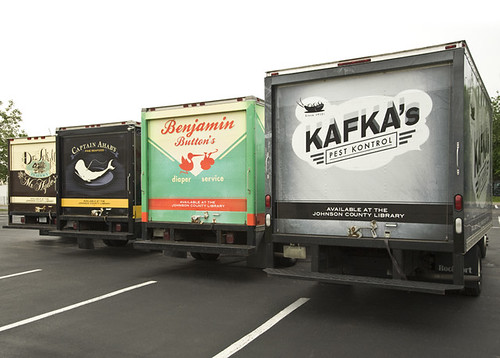
$5000 for one of the best library ad campaigns I’ve seen

I put this on Twitter last week while I was trying to figure out how to get permission to post one of these photos. The link got buzzed around really speedily and the photos were everywhere. I figured I’d drop it here for posterity too. Aren’t these trucks great looking? Another neat thing from Johnson County Library System (KS).

Rangeview (CO) library system 1st system to abandon Dewey

I sort of knew about this for a while but the Rangeview Library District is ditching Dewey in favor of a self-created WordThink system which more closely mimics bookstore categories. No word on whether they’ll ditch that horrible catalog though. They’ve only implemented the switch at one branch so far which means the systemwide catalog returns results with both WordThink and Dewey codes. Press coverage is the predictable “uptight librarians forced into uncomfortable situations by open minded knowledge workers!” and I have the same old twitch when I see libraries referring to patrons as customers.

That said, it will be interesting to see now just how this works in the new library but how it makes that library play with other libraries who use other systems Is ILL affected? How do you locate a book on the shelves (by author?) What are vendors saying about this and what are the ramifications for all the copy-cataloging that happens? I’m definitely just barely able to understand the longer range implications, but pretty much happy to see people trying things. More discussion on MetaFilter where someone included this terrific poem.

Dewey took Manila
and soon after invented the decimal system
that keeps libraries from collapsing even unto this day.
A lot of mothers immediately started naming their male offspring ‘Dewey’
which made him queasy. He was already having second thoughts about imperialism.
In his dreams he saw library books with milky numbers
on their spines floating in Manila Bay.
Soon even words like ‘vanilla’ or ‘mantilla’ would cause him to vomit.
The sight of a manila envelope precipitated him
into his study, where all day, with the blinds drawn,
he would press fingers against temples, muttering ‘What have I done?’
all the while. Then, gradually, he began feeling a bit better.
The world hadn’t ended. He’d go for walks in his old neighborhood,
marveling at the changes there, or at the lack of them. ‘If one is
to go down in history, it is better to do so for two things
rather than one,’ he would stammer, none too meaningfully.

One day his wife took him aside
in her boudoir, pulling the black lace mantilla from her head
and across her bare breasts until his head was entangled in it.
‘Honey, what am I supposed to say?’ ‘Say nothing, you big boob.
Just be glad you got away with it and are famous.’ ‘Speaking of
boobs ..’ ‘Now you’re getting the idea. Go file those books
on those shelves over there. Come back only when you’re finished.’
(John Ashbery, ‘Memories of Imperialism’, listen to it here)
Some Vermont library statistics, fyi

So, I gave a short talk at the Library 2.0 Symposium at Yale on Saturday. Put on by the Information Society Project, it was a gathering of people ruminating on the nature of future libraries. Only a few of the participants seemed to know our profession’s definition of Library 2.0 but that didn’t seem to matter much. There are some great summaries of the panel discussions on the Yale ISP blog. Most people there were academic, but I did get to hang out with Josh Greenberg from NYPL and see Brewster Kahle talk about the Internet Archive’s book scanning project. My general angle was that while we talk a lot about the “born digital” generation, there are still places here in the US — hey, I live in one — where the sort of network effect that is necessary for 2.0 sorts of things still eludes us. We each got about ten minutes and I could have used twenty, but you can look at my five slides if you’d like.

The whole day was worthwhile, but it’s somewhat ironic that we were encouraged to use twitter and blog our reactions while the room the panel was in had almost no wifi and no outlets. I don’t know why this sort of thing still surprises me, but I just felt that a high-powered panel would be able to receive high-powered tech support and handle things like this. Not so.

Today we got notification that public library statistics are available for Vermont and got a link to this page. No HTML summary so I’m going to pull out a few things that I thought were notable so maybe other people can link to it or maybe I’ll crosspost on the VLA blog.

  • Vermont has 182 public libraries, the largest number of libraries per capita in the US.
  • 174 of these libraries have Internet access; 160 of these have high speed access. Do the math, that’s 14 libraries with dial-up and eight with nothing.
  • Half of the public librarians in the state have MLSes or the equivalent.
  • 73% of Vermont library funding comes from local taxes; 27% comes from other local sources (grants, fundraising)
  • Eleven public libraries filter internet access on all terminals (as opposed to some libraries that offer a children’s filtered option)

The library that I work in serves about 1300 people and is open nineteen hours per week. We’re the only library at our population level (serving 1000-2499 people) that loaned more books than we borrowed via ILL. Ninety-six percent of the service population have library cards. I’m still reading for more details, fascinating stuff really.

The Darien Statements on the Library and Librarians

I missed the summit type thing on the future of libraries in Darien a few weeks back so I’m really enjoying getting to read the work product from that meeting. I think sometimes our profession suffers from a lack of focus, though that may just be me talking about my own shortcomings. In any case, please read and comment The Darien Statements on the Library and Librarians