Banned Books Week 2011, a web content rundown

It’s time for my semi-regular round up of Banned Books Week websites. You can look at past posts on this topic by checking out the bannedbooksweek tag here or here is a list of the annual posts More on the Chicago Defender.
Here are my old Banned Books Weeks posts: 2000, 2001, 2002, 2003, 2004, 2006, 2007, 2008, 2009 and 2010. I skipped 2005.

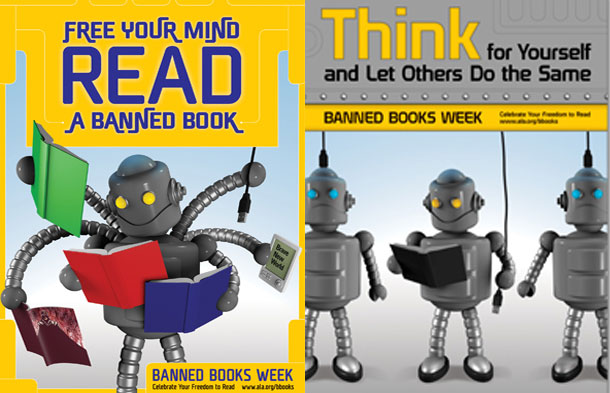
As usual, you get a neat real-time look at what’s going on by following the Twitter hashtag. As usual there are two “main” sites the ALA site at ala.org/bbooks and the bannedbooksweek.org site. ALA has their usual site, links to shopping, links to the main site (which is a 404, oops), links to advocacy materials. They decided to do a virtual read-out instead of an in-person event and I’ve been clicking through some of the YouTube videos on the BBW channel. All the stuff I’ve seen so far seems like it would be what we call SFW [safe for work] and I’m vaguely curious if there could be something so racy that you’d get one of those “You have to be 14 to see this video” warnings up because, hey, that’s its own form of limiting speech. But I think that stuff is only for photos of people in their underwear, or maybe self-reported. The Banned Books Week main site has been up and down today and seems to mostly be pointing to the same stuff. They have a Twitter account but have never used it. The design gets better every year.

Here is the list of organizations who are co-sponsors. Let’s look at their websites.

There is also the Center for the Book in the Library of Congress who endorses Banned Books Week (though no link on their site?) as well as a few organizations who have signed on as sponsors

So I’d cautiously call this an improvement over last year. More coordinated programming, better talking between sites. I’m still looking for a good Banned Books Week Twitter list [i.e. with the sponsors] and if I don’t see one I guess I’ll make one. I’ve been enjoying the YouTube videos. My own tastes this year go to ebooks and thinking about, with the additional layer of middlemen in the ebook world of buying, licensing and lending, what it really means to be banned or censored an an ebook universe. Look for a post about pirates later in the week.

Thief does research, finds hidden passage to secret library and steals books. Old but good.

I’m afraid my burning passion overrode my conscience. It may appear selfish, but I felt the books had been abandoned. They were covered with dust and pigeon droppings and I felt no one consulted them any more. There was also the thrill of adventure – I was very scared of being found out.

Book thief explains why he stole 1,100 ancient books in a hidden room in a monastery library. The theft and the sentencing happened several years ago but just popped on to my radar and resulted in my finding another neat source of library/security information, the library theft category fo the Museum Security Network blog. Current posts are password protected but they become available after a while. Here is their post on what drives people to steal precious books.
Details of the secret room didn’t make the major media, but can be found in this Masters thesis on bibliokleptomania

“While some structural details are uncertain, many accounts agree on certain aspects of Gosse’s methods. The journey inside required him to scale a sheer exterior wall, which led to an attic workshop, which is now part of the hotel. From there, he followed a disused corridor to the next building. At the end of the corridor, he climbed down a very old rope ladder to a small sealed room. By pushing on a portion of the wall, he discovered that a bookcase inside the next room gave way. He then found himself standing inside the library.”

[via]

an ebook is not a book, discuss?

I had a busy week. It wrapped up in the lovely state of Maine where I got to talk about the digital divide and ebooks to a bunch of Maine librarians. The digital divide talk is probably one you’ve seen various versions of, but the ebooks one is more or less new. My assertion is that the problem of ebooks is the problem of multiple perspectives [readers and authors and publishers and librarians don’t even agree on the landscape, much less the trees] as well as the problem of metaphors. At its core, one of the difficulties in teaching people about technology is that it’s teaching people to manage real invisible things [files, websites, social content] through a series of metaphors [“folders” “tagging” “friending”] that are more or less complex depending on people’s level of existing knowledge. While the printed word and language generally is something of a metaphor, you can read a book without really having to think about that level of abstraction. We’re not there yet with ebooks and the metaphors confuse the reality, a reality that is still shifting, hopefully moving towards if not some standards, at least some etiquette.

In any case, both talks are here. I got a lot of good feedback on my general topic from Twitter and other social media interchange arenas. Thanks to those who helped me with this, and thanks to the nice librarians from Maine for coming to listen and talk.

backlists and frontlists

Hello faithful RSS readers and anyone else who is sort of curious what’s been going on. I’ve been feeling like I’ve been getting my brain back this Summer and I appreciate your patience with what has been a trying set of months. I did go one place, and that was to North Texas during a heat wave where I decided to (mostly) quit smoking and got to hang out with some neat local librarians and some fun folks who I already knew at the Library Tech Network TechNet 2011 Conference. I gave two talks which you may already have read, but in case you’re interested you can click through and check out Tiny Tech/High Tech and On the Fly Tech Support.

This month I’m heading to Cambridge for a DPLA meeting and then to Augusta Maine for a one-day meeting about Ebooks and Libraries which is sure to be interesting and informative. I’m giving a lunchtime talk but also leading a breakout session called “Ebooks are Great! Books are great!” talking about the differences between books and ebooks. Based on some of the feedback I’ve been getting on Twitter and elsewhere, that will be a lively topic.

Next month I’ll really be scooting around a bit and my drop-in time and evening Mac classes are starting up locally which will keep me busy and pretty happy. Anyone attending the NELA conference, the Michigan Library Association conference or the CLIR symposium in Milwaukee, please do say hello. In the meantime I’ll be updating somewhat more here and getting back to my own RSS reading so I hope to be less of a stranger.

Helping libraries damaged by Hurricane Irene


Image, which I hope is self-explanatory, by Darien Library.

One of the first places I went after the storm was over was the local library. I was supposed to work the day earlier because our librarian literally couldn’t get to work, but then wound up not working because there was no power at the library. My local library suffered no storm damage. Other libraries weren’t as lucky. The Department of Libraries in Vermont has been terrific both in trying to contact every library as well as informing the other librarians statewide about what needs to be done, who is in trouble and how to apply for FEMA grants now that libraries are an essential service (again thanks thanks thanks to all the people who lobbied to have that done). Here are some links to people doing things that may be instructive or useful for you either in figuring out who to help or in managing crises like this in the future.

I’ve spent a lot of the past few days checking out the pages on Facebook where a lot of the communication about the recovery efforts are taking place. In case you’re curious, here are some of the pages where a lot of the local recovery work and information dispersal is actually happening

I’ll probably talk more about the upsides and downsides to using social media for this sort of thing, but the upside is it worked. People got information and they got help because they had access to things like Facebook and Twitter through their phones when they didn’t have any electricity, telephones or computers. Worth learning about.