I’ve always thought that one of the troubles with librarianship was that there are always more great ideas and projects than anyone has time for or can get funding for. As a result we outsource projects to the people who have time and money and thus lose control over the end product. I have no idea if Library Thing’s open source Open Shelves Classification Project is going to wind up looking like a library product or a vendor product, but I’m curious to find out. As Tim Spalding says “You won’t be paid anything, but, hey, there’s probably a paper or two in it, right?” I haven’t seen much chatter, blog or otherwise, about this just yet but I’ll be keeping my eyes open. Whether or not this project it ultimately successful, I think it’s an interesting grass rootsy way of looking at ideas of authority and rejecting the top down let-us-have-you-contribute-and-then-sell-it-back-to-you models we’ve been working under.
Category: books
Working towards more public books, fewer orphan works
Public domain determination becomes clearer cut, more books entering the public domain thanks to … Google? Jacob Kramer-Duffield explains how Google and Project Gutenberg and the Distributed Proofreaders put their book-scanning and OCR-ing smarts into trying to solve the thorny orphan works problem to determine which out of print books have had their copyrights renewed and which haven’t. Neat. [via joho]
Reading: Revolting Librarians Redux Remains
John Miedema wrote a review of Revolting Librarians Redux on his blog and also announced he’ll be coming out with Slow Reading the book, through Litwin Books. I was surprised during my last set of talks that there were librarians who had copies of RLR (and asked me to sign them) at both places. My co-editor on that book, K.R. Roberto has also come out with Radical Cataloging which looks like it will be a similarly irreverent and yet serious look at another part of our profession. With essay titles like “This Subfield Kills Fascists” and “Dr. Strangecataloger: Or, How I Learned to Stop Worrying and Love the Tag,” it should be on every cataloger’s desk.
book scanning for patrons
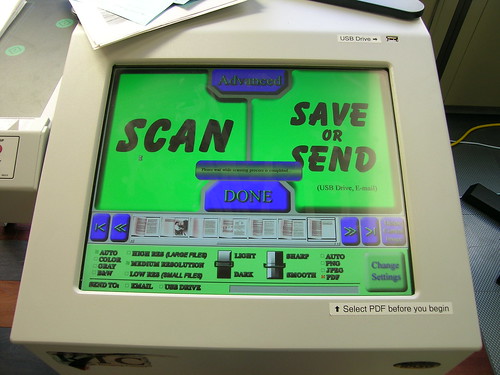
photo originally from akseabird
I’m pretty skeptical when people call anything for sale “revolutionary.” However, a friend sent me this photo which was up on Flickr. It’s a tool called the Bookeye book scanner. It’s a library digitzation product, but if you look at the photo, it’s being used as a tool for the public — or University of Alaska at Anchorage students — to scan documents to PDF, JPG, TIFF or PNG and then save to USB drive, burn them to a CD, ftp them, save them to a network drive or email them to themselves. Their website even has usage stats that shows what people did with the first million pages they scanned. Good data, and it’s broken down by library type which is even more interesting to me, to see the differences in usage patterns. [thanks manuel]
ISBNs in the age of digital books
Some observations from Peter Brantley about what ISBNs will do in an age of digital books and multiple intermediaries between “publishers” and “readers.”
We are rapidly jerking forwards into a near term future where ISBNs will be assigned for derivative digital book products by intermediaries, not publishers. As an astute colleague observed in New York, the ISBN becomes a product SKU.
There are many disadvantages in this; one is that it will become increasingly difficult to find the “book†in the tangled weave of various digital instantiations. Perhaps no longer will we be able to ask how many copies did EduPunk 2020 sell.