a librarian’s guide to watching the Olympics

So I like the Olympics. Not like I wait for it all year, but I enjoy the spectacle, fresh-faced athletes, international competition, and an excuse to watch TV with friends. I also enjoy, from a nerd perspective, trivia in the making such as this being the first year that all attending countries have had female athletes on their teams or wondering what Muslim athletes are doing during Ramadan. I’m also fascinated by what I can and can’t see Olympicswise, versus my friends in other countries. Anyone who wants to watch stuff the normal way will have no problem though I do suggest the Easy Read version of the London 2012 site because it’s more straightforward and has less cruft.

So if you’ve been following along, you know that there was a big social media aspect to the opening ceremonies, which had some live tweeting which was already ancient in internet-time by the time the show was broadcast in the US. There was also some controversy concerning some parts of the opening ceremony that were edited out of the US broadcast. I have been sitting at home healing from a sprained ankle so I have been a little more immersed in the meta-story than I might be otherwise.

Anyhow, in my sometimes-role as the internet’s librarian, the question I’ve been seeing a lot is “How do I watch an Olympic thing when I can’t because of $_REASONS?” Now that reason may be because you’re in the US and so you can’t stream the BBC, or because you’re in an African country and don’t have cable, or in the US and allergic to Bob Costas.

It’s not super clear how to do some of these things, and less clear how much end-running these things is problematically extralegal. I will not be addressing the second part, you can consult your own moral compass for that. In any case, I’ve made a little guide which I’ll be updating which help answer some of these questions. The BBC even made two versions of their Opening Ceremonies coverage available, one with the BBC commentary and one without. For people who only saw the goofy NBC version of the ceremony, this English guide to the ceremony (pdf) may be helpful as well as this songlist. Note: I’m linking to MetaFilter, my employer, both because I feel like this sort of international social discussion can be helpful during times like this and because I feel that the information has been the most helpful to me personally. I have no other affiliations with the things I linked to. If there are other things you’ve found, please drop them in the comments.

Also notably: I haven’t said anything about bit torrent because I have not-that-fast broadband and I don’t use it much, but most recorded Olympic events are available for download from the usual places.

Jessamyn’s Guide on How to Watch the Olympics

A few relevant Ask MetaFilter threads

http://ask.metafilter.com/220992/This-is-the-Internet-age-is-it-not
http://ask.metafilter.com/220934/How-to-watch-2012-Olympics-online-in-Africa
http://ask.metafilter.com/204681/How-to-watch-the-2012-Olympics-after-cutting-the-cable
http://ask.metafilter.com/221049/How-can-I-watch-whole-Olympic-basketball-games-online?
http://ask.metafilter.com/219388/Help-me-watch-the-Olympics-on-my-computer

Summarized:

– Get someone with a UK VPN to let you borrow it and watch BBC coverage via YouTube(what is a VPN? nerdy VPN details)
– Pay money for a good UK VPN [suggested: what’s on the box, unblock-us.com, VyperVPN]
BBC Player or Expat Shield if you have a PC , TunnelBear if you have a Mac
– I was watching Olympics on BBC1 earlier via this link
YouTube’s Olympic coverage is free for Asia/Africa, best place to start if you have the UK VPN working
– In the US, use a friend’s cable account login and watch NBC online
this Deadspin thread seems to have ongoing new links in the comments, notably [www.vipbox.tv] which seems to work

Other “cord cutter” guides (what is a cord cutter?): GigaOm, reddit, iamnotaprogrammer pictorial (discussion on hackernews)

And if you’ve just had it already? This browser plugin might be for you.
Can’t keep up? Consider this IFTTT recipe (What is IFTTT?)
Just the facts? The cross-linked medal table at Wikipedia should help. Someone is doing a bang-up job writing stubs for many of the atheletes.
cloudsourcing – NELA-ITS program about the cloud

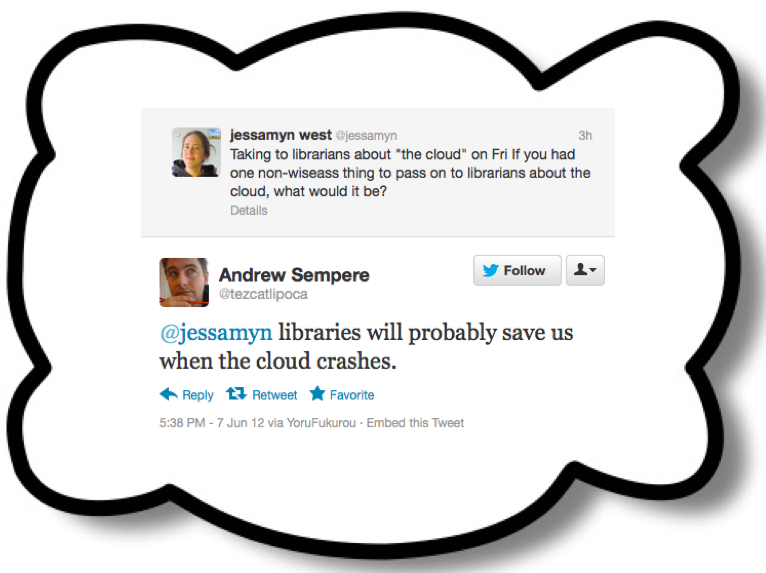
I was in Worcester yesterday at their lovely public library at a NELA-ITS event with the amusing title “Cloudy with a Chance of Connecting to the Future!” I gave a pretty straightforward talk about what libraries need to think about when they think about cloud technologies. And, for a meta aspect, I asked folks on Twitter for suggestions and advice about how to limit the large amount of stuff cloud-related that I wanted to talk about. I skipped my usual “Web page with list of relevant links” format, but you can see my slides and notes via this pdf if you’re interested. More to the point I wanted to link to the sources that I used that I found really helpful.

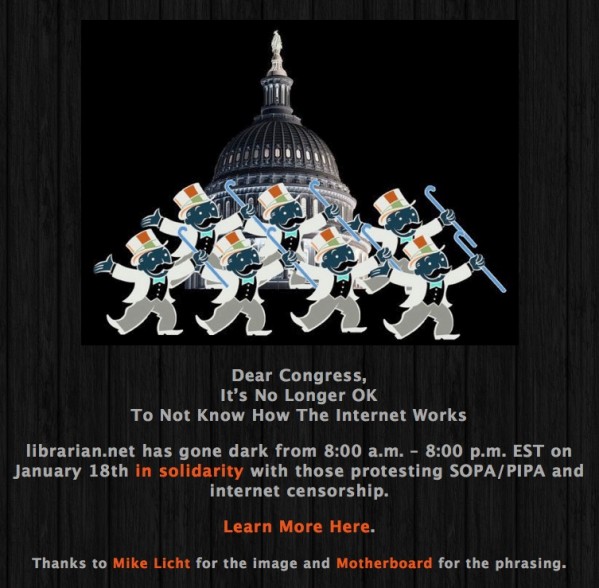
“What do they expect us to do, go to the library?” a wrap-up of the SOPAstrike

Congress, it's no longer okay to not know how the internet works.

I was surprised by how much activity there was yesterday over SOPA/PIPA.

If you’ve been following along, you’ll know that SOPA/PIPA are the House and Senate versions of a bill proposed to address the proliferation of websites that facilitate access to copyrighted content for free. I’ve spoken previously about my opposition to this legislation and took action by making my site, Casino online t?i Complete Sports, go dark using a WordPress plugin to register my displeasure. On MetaFilter, we created an interstitial clickthrough page so that everyone visiting the site would see it and be encouraged to contact their representatives if in the US, or take other actions for non-US users. I knew other sites were taking similar measures, most notably Reddit, but I was personally surprised at just how big it got and how quickly.

And by the time I called Patrick Leahy, the guy who was actually responsible for drafting PIPA, and his Montpelier office said they were having technical difficulties and to please call the Burlington office, I knew something was up. And I spoke to a staffer who clearly thought I was some sort of “Hey the internet sent me” person, telling me “It’s not like Google says it is” and seemed surprised though maybe not pleased when I went into the details of what my objections to the law were. And I used the internet like usual, except things weren’t usual. Wikipedia was dark (read this link for some laughs). Reddit was dark. BoingBoing was dark. Cheezeburger network and Craigslist had clickthroughs. Google did a custom logo. In fact I found it a little tough to predict which sites might go dark. The Syracuse iSchool had a very well done page. ALA hadn’t done anything in the morning but thanks to a little nudging, had a message of support up in the afternoon. The protest made the news. Here’s a quick roundup of some screenshots I made, in case you missed some or all of them. And, to bring this full circle, here’s Jon Stewart talking about how this sort of thing just might drive people back to the library.

Ultimately what is interesting to me is what happened. Several legislators changed their votes (check yours here). It was interesting seeing these roll in over Twitter before turning into more official sounding statements later in the day. At last count twenty senators announced opposition to the bill this week. Check this graphic. That, to me, is sort of a big deal.

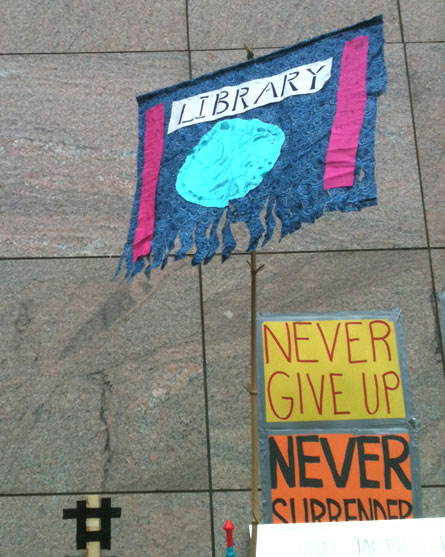
The temporary autonomous library at Occupy Boston, an interview with Kristin Parker


all photos courtesy of Kristin Parker, please do not reproduce without permission

I have friends working in the various Occupy X libraries. We don’t have a very big Occupy presence near me in Vermont and I was curious how things work there. Kristin Parker (@parkivist) is an anthropologist who received an MS (Simmons) with a concentration in archives management. She worked for twelve years managing the collections exhibits and archives at the Isabella Stewart Gardner Museum and is now managing the art collection at the Rose Art Museum at Brandeis. She’s a newish associate of the Boston Radical Reference Collective and is one of the people who has been organizing and staffing the A to Z (Audre Lorde to Howard Zinn) Library at Occupy Boston. I asked her a few questions over email. She writes…

“The A-Z Library is a partnership made up of the Boston Radical Reference Collective, the Progressive Librarians Guild of Simmons College and Metacomet Books of Plymouth, MA, run by John Ford who recognized a need for a durable setting for books at Dewey Square (the Occupy Boston site). He graciously installed a military tent and brought in a third of his own personal book collection. Other donations soon arrived through the librarians and members of the public. The library has been up and running for more than 2 weeks now. Every day we receive donations – it’s amazing. Books are organized according to subject, in plastic milk crates and wooden cranberry bog crates, for easy transporting and shifting. As described in the statement (link below): ‘The library aims to provide high-quality, accurate information to all interested parties. The collection contains material on topics such as political thought and social movements, activism, history, philosophy, religion, ????? finance, consumerism, gender, race, as well as a large fiction section.'”

What your role is with the Occupy library in Boston and could you suggest a few links for people interested in the Occupy Library System generally? Continue reading “The temporary autonomous library at Occupy Boston, an interview with Kristin Parker”