Wikipedia work in 2025

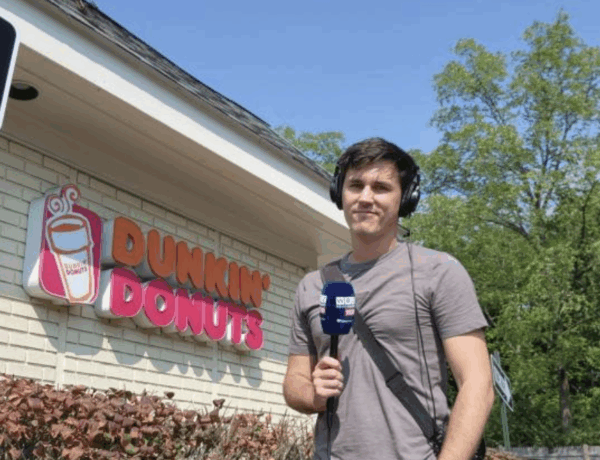
Matt Shearer, a radio host, standing in front of a Dunkin Donuts wearing his radio gear and holding a microphone.
I slid into Matt Shearer’s DMs and asked him for a photo to illustrate his Wikipedia page. He graciously provided one.

Wikipedia is one of my hobbies. While I think it might be good to have some offline hobbies, winter is long and I’m really a pathological sharer, so this works for me. Recently, someone replied to a FindAGrave query I’d sent them over two years ago asking for permission to use an image, saying “Yes, please feel free to use that family photograph we shared of George Heron Milne on his Wikipedia page!” and it was as satisfying as finishing a 1000-piece jigsaw puzzle. Hmmm, maybe jigsaws are a good offline hobby? Here’s a loose summary of the Wikipedia work I did this year.

– Uploaded 109 images to Wikimedia Commons, mainly things from Flickr Commons but also a whole set of Vermont state Senators from 1900 which we had in a book at the historical society. (see them)
– Uploaded 8 images to Wikipedia, these are fair use images where an image can’t be added to Wikimedia Commons. (see them)
– Wrote 25 articles, entirely biographies except for one disambiguation page which isn’t really an article. Four of them were for people who live or lived in my small town. (see them)
– Made 682-ish edits.

I did a bit more noodgey editing this year, meaning that I sometimes edited because someone was wrong on Wikipedia (usually because they were editing a page that they had a conflict of interest with, it’s a whole thing). I learned to use a few more tools and continue to do my mostly “lone wolf” thing where I’m not really aligned with a project or work group, I just mainly do my own thing. That thing includes, among other things, adding images of librarians to Wikipedia. I’ve got a list.
Wikipedia work in 2024

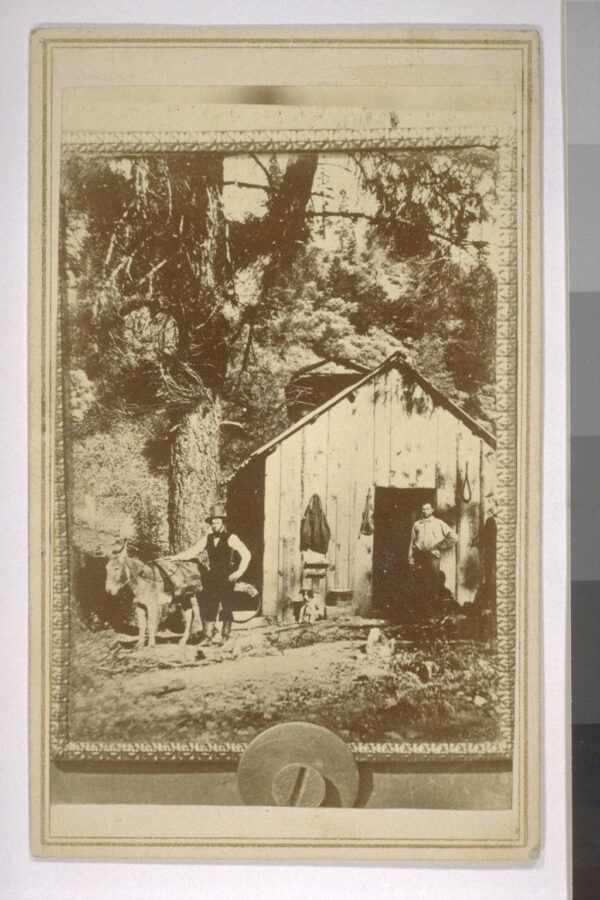
A very old photograph of two men and a burro standing outside a small wooden shack in the middle of a forest with immense trees.  One man is wearing a dark top hat looking had and a dark vest over a white shirt and solid boots. The other man is wearing a workshirt but is otherwise in shadow. The donkey is wearing a pack. The image has a small metallic frame and appears to be held in place (where?) with a screw at the lower center of it.

I do work on Wikipedia sometimes. Since I’ve been working for the Flickr Foundation, my life overlaps more with free content. Sometimes I try to combine work and play and add things to Wikimedia Commons, or to Wikipedia, or both. My username in the Wikipedia extended universe is Jessamyn, so it’s pretty easy to see what I’ve been up to. Here’s my wrap-up of 2024 Wikipedia stuff I did.

– Uploaded 81 images to Wikimedia Commons (see them)
– Uploaded 15 images to Wikipedia (usually for obits, or logos, cases where the image doesn’t have a free license, see them)
– Wrote 33 articles (see them)
– Made 755 edits.

It was a decent year. My absolute favorite thing from the year was finding this “selfie” of M. M. Hazeltine (above). Hazeltine was a photographer born in Vermont in 1827. He went out West to seek his fortune, came back to Vermont, learned photography, and went back out there. This image from the 1850s was taken when he and his brother were working a gold claim in California. It was in UC Berkeley’s special collections and I think I found it through Calisphere. One of the weird things about a lot of public domain images is that stock photography organizations tend to scoop up images that are publicly marked as public domain, put their watermarks all over them and try to sell them to people. This is legally allowed, but because of the way search engines work, it can be tough to find the original public domain images. Having those images on Wikipedia helps.

I’m aware that Wikipedia is imperfect. However, it’s a nice hobby for someone into free culture and photography, as I am. This year’s work didn’t feel like too much bored (or grumpy) editing and a lot more “Hey this neat thing should be in there” so here’s to more neat things going in there in 2025.

learning git to share more free stuff

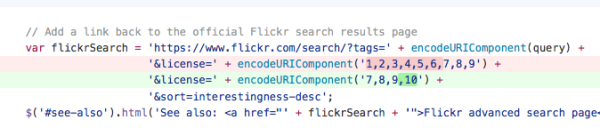
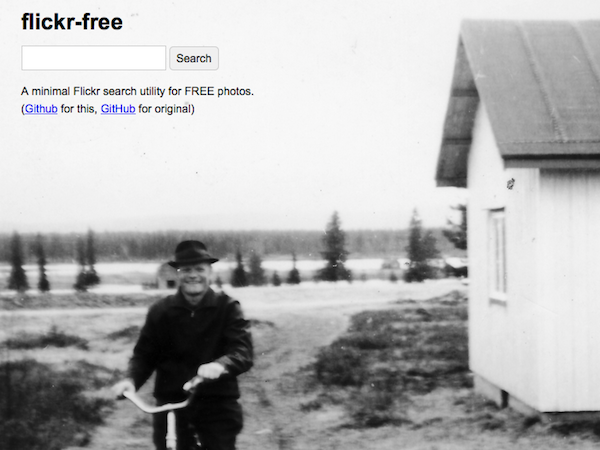
screen shot of the page with the search box I made

I made a thing. It started out with me just reading Twitter. A friend built a thing and tweeted about it.

https://twitter.com/dphiffer/status/714625694005903360

The thing was a super-simple search box which returned content on Flickr that was public domain or Creative Commons licensed. Very cool. However, when I use stuff on my talks, tools or otherwise, I like to make sure it’s free content. Creative Commons is great, I just was looking for something a little different. I noticed the code was on Github and thought “Hmmm, I might be able to do this…”

I’ve used Github a bit for smaller things, making little typo fixes to other people’s stuff. If you don’t know about it, it’s basically a free online front end to software called Git. At this site, people can share a single code base and do “version control” with it. This is a super short and handwavey explanation but basically if someone says “I made a thing, the code is on Github” you can go get that code and either suggest modifications to the original owner OR get a copy for yourself and turn it into something else.

In the past we’ve always said that Open Source was great because if you didn’t like something you could change it. However it’s only been recently that the tools to do this sort of thing have become graspable by the average non-coder. I am not a coder. I can write HTML and CSS and maybe peek inside some code and see what it’s doing, maybe, but I can’t build a thing from scratch. Not complaining, just setting the scene.

So, I “forked” this code (i.e. got my own copy) and opened it up to see if I could see where it was doing its thing and if I could change it to make it do something slightly different. Turns out that Flickr’s API (Advanced Programming Interface) basically sends a lot of variables back and forth using pretty simple number codes and it was mostly a case of figuring out the numbers and changing them. In this image, green is current code, red is older code.

a copy of the code showing what was changed.

The fact that the code was well-commented really helped. So then I changed the name, moved it over to space that I was hosting (and applied for my own API code) and I mess around with it every few days. And here’s the cool thing. You can also have this code, either Dan’s which searches free and CC images, or mine which only searches for free images. And you don’t have to mess with it if you don’t want. But if maybe you want to use the thing but make a few of your own modifications, it’s easier than ever to do it with something like Github. Please feel free to share.

If you’re always looking for more ways to get public domain and free images, you may like this older post I wrote.

I need to find a public domain image of _______. How do I do that?

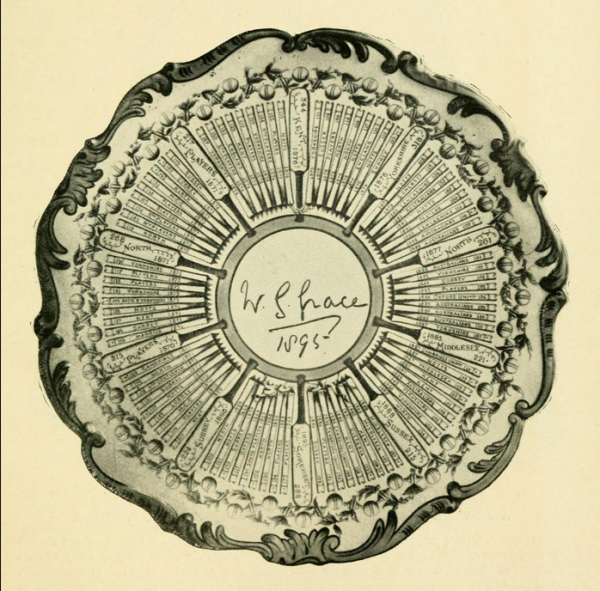
commemorative cricket plate

Reference question of the day was about finding public domain images. Everyone’s got their go-tos. If I am looking for illustrations or old photos specifically I’ll often use other people’s searches on top of the Internet Archive’s content. Here’s a little how to.

1. Check the Internet Archive Book Images feed on Flickr. What I often do is search (which finds the words that surround the images) and then click straight through to the book (which is always linked in the metadata) and then fish around. For example…

Why SpaceX photos aren’t public domain (yet)

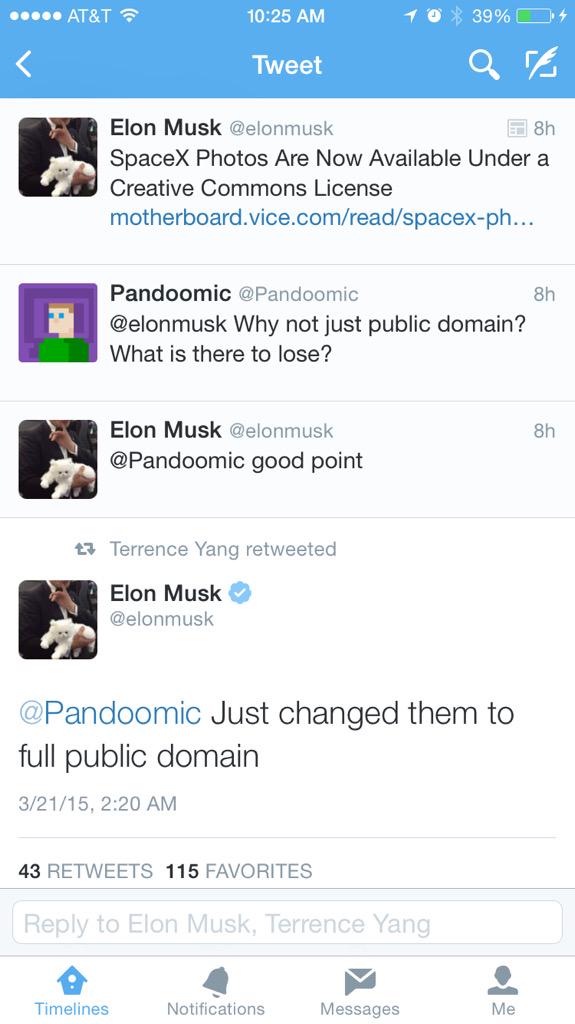
Sometimes people who license their digital content aren’t really thinking it through. They may have something else on their minds or copyright nuance may not be their thing. I think it behooves us copyright advocates and activists to (at least) politely try to push the envelope towards more open content licensing. Here’s the example I enjoyed from today.

CAo0fKXUMAA2Nfq.jpg-large

This is interesting especially because Flickr uses Creative Commons licensing, but does not use CC-0 which is an intentional choice. Photos from cultural heritage organizations which are in the Flickr Commons have an additional “no known copyright restriction18comixoption that is only available to specific accounts, not any Flickr user. There are many ways this specific issue can be resolved but just the fact that it’s generally a hurdle that has to be overcome indicates that there is still a good role for copyright reform advocates to play. More supporting links: Original article & SpaceX photos on Flickr.

Update: I made this into a longer Medium post.

Why SpaceX’s photos (maybe) aren’t public domain