book burning threat makes headlines in WI challenge dispute

I read this CNN article about a group in Wisconsin who has been fighting with the West Bend Community Memorial Library over the group’s desire to have a long list of YA books moved to the adult section of the library. Their challenge failed, but there’s a lawsuit pending.

The news article has the predictable all-over-the-place approach to the issue but it seems that this is one of those fights that has everything including outraged parents, a beleaguered library board whose members don’t have their terms renewed, assertion of First Amendment rights, threats of book burning, and a lot of homophobic-sounding nastiness. The article, though on the web, also doesn’t seem to understand the usefulness of hyperlinks to telling a story that is playing out on the web so I have added them here

I really wish the library or the city had more accessible public statements about this whole ongoing mess.

getting dad a library card

dad at the library

I’m visiting family before I head back up to Vermont. Yesterday I convinced my dad to go get a library card in the town he’s lived in for ten years. My dad is one of those “Hey, why borrow it when you can buy it?” people but we trundled over to his library anyhow because I wanted to see it and while we were there, I suggested he get a card.

Let me first mention that even though the experience at the library wasn’t great, I totally understand why that was the case, and I’m not trying to do any public shaming thing here (hence no link). I just think that there’s a sense in which we’re always saying “Hey libraries are more popular than ever!” but there are also people who just plain old never use the library — one of the big challenges of outreach is to identify these people and see if there are ways to make the library appeal to them — and I wouldn’t be surprised if my dad is one of them.

So, we went to the library. The library is being renovated so it’s a bit of a challenge to get inside, lots of uneven sidewalks and unclear signage. My dad is seventy and doesn’t really like being outside of his comfort zone so we were already a little confused when we got there. We went to the circ desk which was being staffed by one obvious volunteer and one person who may have been circ staff or may have been a librarian or who may have been both. No one had name tags. The woman at the desk was doing the typical multi-tasking thing, helping a lot of people at once, and asked my dad “Can I help you?” He said he was there to get a library card. She went off to get the forms he needed to fill out. Actually I knew that was what she was doing. To his mind she just turned away and started answering someone else’s questions and left us standing there.

She came back and asked for some identification and my dad gave her his driver’s license which showed that he lived in the town. At this point I sort of expected a “Oh you’re not a summer tourist!” awareness but that didn’t happen. She handed us a form and told us to fill it out and meet her at the reference desk (about five feet away) when we were done. The form was your standard one page application. This is a photo of my dad filling it out. We waited for her to come back to the reference desk for about five or ten minutes while she continued to answer other people’s questions (someone needed to use a computer, someone couldn’t find the phone books). At one point she got up to show someone where to find something and then she came over to us and said to the circ staff “I’m going to help this man because he’s been waiting so patiently” which I found a little odd. The library had what seemed to be a normal amount of people for a Monday afternoon, and yet it seemed chaotic for whatever reason.

We then stood by the reference desk while she retyped what my dad had written into the computer. She had trouble reading my dad’s email address (he writes in all caps) and made him read it out loud to her a few times. His email domain is tomandcindy.com and she crossed out what my dad had written and wrote it out underneath with an ampersand in it. My dad had to politely point out that email addresses don’t have ampersands, ever. I couldn’t figure out why she couldn’t see what his email address was by reading it, maybe I’m just attuned to his writing. After doing this, she handed us a card and asked “Can I help you find anything?” We said no and left. No welcome brochure, no “welcome to the library!” nothing.

Turns out the library had sent us a welcome email which we got when we got home a few hours later. It included a link to the catalog and some information about the library network and, of course, my dad’s library card number and PIN in plain text (libraries are not alone in this terrible practice, but it makes me cringe nonetheless). My guess is that my father will never go back to the library. There was some good-natured ribbing about this when we got home. I’m aware that it’s not the library’s job to make all sorts of different people feel like it’s their very own place and cater to their every need and personality tic, but then again it sort of is, isn’t it? I’ll be thinking about this some more while I think about how my library welcomes new people to the community.

today is one of those library firsts days

Today is, if you believe The Writer’s Almanac, the date in 1731 that Ben Franklin founded the first circulating library. The blurb is neat to read but short on references, so here is me fleshing it out a little.

It was on this day in 1731 that Ben Franklin founded the first circulating library, a forerunner to the now ubiquitous free public library. He started it as a way to help settle intellectual arguments among his group of Philadelphia friends, the Junto, a group of civic-minded individuals gathered together to discuss the important issues of their day.

Each of the 50 charter members bought an initial share into the company (40 shillings), which helped fund the buying of books, and then paid a smaller yearly fee (10 shillings) that went to buying more books and maintaining the library. In exchange, the members could borrow any of the books. Donations of books were gladly accepted.

They called their charter the Library Company of Philadelphia, and the next year, Franklin hired America’s first librarian, Louis Timothee. At first, the books were stored at the librarian’s house, but by the end of the decade, they were moved to the Pennsylvania State House, which is now known as Independence Hall.

The Howe library in Hanover New Hampshire

Howe Library - bookplate

Yesterday I got on the highway and went for a trip out to the Howe Library in Hanover New Hampshire. I took some photos. Mary White who was my gracious host when I spoke at Marlboro College a few years ago is now the director there. She had been in touch with a former Marlboro student who is now fresh out of library school and looking for work in the area — please hire Tyler (old blog, new blog, twitter), he is a smart, engaging involved person — and was having an informal chat with him and invited me out to see her library and meet Tyler. Apparently Tyler was partially inspired to his professional path by my talk/presence at Marlboro. Neat.

This is one of the things I think we don’t so much talk about in the blog-twitter-facebook world of librarianship — how important mentoring and personal connections are to getting, finding, and keeping work. Mary and I both had some identical pieces of advice for Tyler: join a professional association and try to go to the NHLA conference in May. I remember when I was first in library school and joining WLA and ALA, there were more experienced librarians who took me under their wing and sort of showed me how it was done.

The other thing I took away from my quickie visit was how much of what’s wonderful about the Howe — a library I’ve enjoyed going to since I first moved to the Upper Valley but haven’t been back to in a while — is the attention to detail that Mary and others bring to the place. Sure, the library has a great website that they hired a local company to create. There are TONS of signs in the library, many little nook-like places to sit, nice spaces for people to work in (tech services has windows), many interesting ways to say “thank you” to people for donating money or efforts, a year-round booksale and even a free hour of parking if you need to use the parking garage because the lot is full. Anyone in the area who wants to see a loved and loving library should wander down to the Howe and say hello to Mary.

My local library gets an award!

Librarians at my town library — Kimball Library in Randolph Vermont — win the Paul Howard award for Courage. I wish I could say I had anything to do with any of this, but I was away at ALA while all of this was going down. This award is good news. Just yesterday at town meeting the head of our our library trustees had to defend the decisions that the library made during that difficult time whch included the fact that the library received an apology from the police for their illegal request of the library’s public computers. Meanwhile, the library has to reduce hours due to decreased funding.

on metadata and the printed word

last checked out in 1963

I went to the Belmont Public Library this weekend because it’s my boyfriend’s local library and he is, as you might suspect, a heavy library user. The library is in an old building that is clearly reaching the end of its usefulness as a 21st century library, but they seem to do the best they can. They are part of the Minuteman Library Network which means they have access to a lot of consortium-level technology which can really help out when you’re working in an institutional-green building with furniture from the late seventies. I had a good time there in any case and I took some pictures including the one above.

What first got me about this book was that it hadn’t been taken out since 1963. Well, that’s not quite correct. We know it was checked out in 1963 and was possibly checked out after [whatever date the OPAC took over] a date I don’t know. What occurred to me later as I looked at this picture is how much else we know about this book simply by looking at this card.

  • the date the book was acquired by the library
  • the title of the book
  • the last name of the author of the book
  • The patron number of the person who checked the book out last
  • the call number of the book
  • the library the book is from
  • the lending period of the book
  • the date the book was last checked out (before the OPAC)
  • the fact that the library card pocket was union made

That’s a lot of data. I can also, using that data, find the full text of this book both at the Internet Archive (a little messed up, for some reason) and as PDFs (with images) at the Google Books project which is searchable. In fact, there appear to be three versions of this book on Google Books (1, 2, 3) only one of which includes page two which has a photo of the author. Nothing much else to add, just finding this whole exploration process interesting.

Applying for a grant….

firefox users go fuck yourselves, love OCLC & WebJunction & the Gates Foundation

So today my task at the library where I am employed as the nominal “systems” librarian (a very part time job mostly concerned with the eventual automation of the card catalog) was to decipher the procedure for using WebJunction’s TechAtlas (© Powered by OCLC) to do an inventory of our four public access computers. This inventory is mandatory for those applying for funds from the Bill and Melinda Gates Foundation. Here is how my day went.

Our library had gotten a letter from our state librarian including a letter from the TechAtlas people explaining the steps we needed to take to do this. The first step which was strongly suggested but not required was to sign up for a webinar that explained, I suppose, how to do the inventory. My boss wanted to arrange a time where she and I could both be present for the webinar. I got as far as the Wimba set-up asking me to disable my pop-up blocker (do not get me started on the 2.2 MB door card again) and then said I thought we could figure out the process (for our FOUR computers) without it.

The letter had a space where our login and password were provided for us. Unfortunately our letter only had our password and not our login. I called the help number at the bottom of the sheet and talked to a nice lady at NELINET who gave me my login (which was just the password as a techatlas.org email address). She wasn’t sure if it was supposed to be upper or lower case. When I logged in, I had to set up my profile [and choose our own login and password] which included a library name that was not ours. [Note: I fixed this problem, but our "network" still displays a library that is nowhere near us and not related to us]. This occasioned another telephone call to NELINET where they actually had to call the TechAtlas people and get back to me. I had to enter our library’s information — actually my information — on a page with no privacy policy or terms of use. Every time I update an item on my profile page, TechAtlas sends me an email. I have seven emails from them now.

I did track down the privacy policy, not because I’m worried I’ll be spammed but because I think it’s a good idea generally to read them and see what they’re about. Oddly, the privacy policy page in the TechAtlas universe ended prematurely, halfway through the word “statement.” Of course I took a screen capture, but they have since fixed this, making the privacy policy a downloadable pdf, which doesn’t seem super user friendly to me (and hey isn’t that what OCLC just did with another policy…?). Here are the Terms of Service which aren’t in a pdf. There are also the terms of use linked from this About Us page which are a LOT more legalistic. Please keep in mind that if I do not agree with any of these, I am welcome to not use the site and I can not apply for funding in this round of Bill and Melinda Gates Foundation funding.

So, on to the mandatory inventory. This was the first thing that greeted me, a browser incompatibility message (some language nsfw there). What this means, in a more polite fashion is that TechAtlas has some nifty IE tools that can make the inventory process a lot simpler. Firefox users need to do more of the process by hand. You know, that’s fine with me. I don’t like it, but that’s okay. However, acting like this isn’t a series of choices that were made by designers and program managers seems somehow odd. Odder still, when I went home this evening to grab some screenshots, the site now gives me a similar “Browser Incompatibility” message and yet displays that I am using a compatible browser. Apparently Firefox got compatible within the last few hours. I guess this is good news? The part they left out is that my browser is incompatible because I’m on a Mac, not because I’m using Firefox.

So we have four computers and it’s not that difficult to fill in the blanks. For each computer, there are twenty-two fields to fill out, but only five of them are mandatory. We have four identical computers so this was actually pretty simple and you can edit the entries if you get anything wrong. Oddly, one of the questions: “Opportunity Online Grant Funds?” which is asking whether you used this certain grant to get the money to buy the computers originally (a question our librarian wasn’t totally sure about, but was pretty sure) isn’t actually editable after the fact. I hope I chose correctly!

So, it didn’t take terribly long. Most of my time at work today was spent cursing at Overdrive and having to do Windows Media Player updates on computers that are locked down via Centurion guard. What I told the librarian — who is a very nice lady, and sympathetic to my muttering in a “There but for the grace of god go I” sort of way — is that this time around, if they let us, maybe we should get Macs.

Cedar Rapids PL flooding update/interview from Library Journal

The heartbreaking story of the Cedar Rapids public library. Information on the flooding and an address to send donations. Photos and up to date flooding information at the Cedar Rapids Library home page.

Another library on Flickr

“The library structure was originally a hot dog stand operated by Harry Lewis. Lewis’s grandfather, W.R. Surles, owned the land and structure, which he provided for use as a library in the late 1930s.” [read more in the picture comments over at Flickr.]

MLK library in DC when it was new

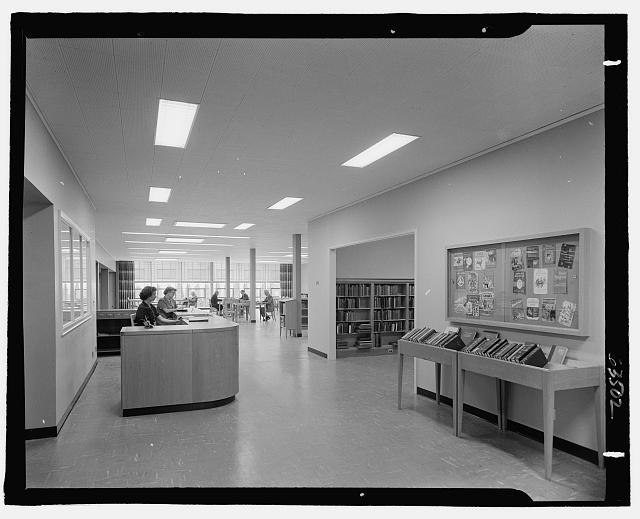
I’ve shown you my sad set of MLK’s Library photos from when I went to DC. My friend Mary Early has found an older, niftier looking set of photos of the same library back when it was new and lovely and full of hope and promise. I wish the Save DC Libraries site looked like it was still alive. The DC Friends site is still kicking, albeit with bad news and the DC Public Library Foundation looks like they spent all their money on web design. Meanwhile DC Public hires teens to shelve books and answer phones which seems like a real good news/bad news situation in a library dealing with massive underfunding and understaffing.