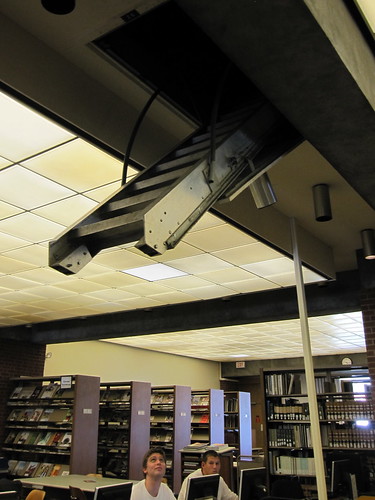
Yesterday I got on the highway and went for a trip out to the Howe Library in Hanover New Hampshire. I took some photos. Mary White who was my gracious host when I spoke at Marlboro College a few years ago is now the director there. She had been in touch with a former Marlboro student who is now fresh out of library school and looking for work in the area — please hire Tyler (old blog, new blog, twitter), he is a smart, engaging involved person — and was having an informal chat with him and invited me out to see her library and meet Tyler. Apparently Tyler was partially inspired to his professional path by my talk/presence at Marlboro. Neat.
This is one of the things I think we don’t so much talk about in the blog-twitter-facebook world of librarianship — how important mentoring and personal connections are to getting, finding, and keeping work. Mary and I both had some identical pieces of advice for Tyler: join a professional association and try to go to the NHLA conference in May. I remember when I was first in library school and joining WLA and ALA, there were more experienced librarians who took me under their wing and sort of showed me how it was done.
The other thing I took away from my quickie visit was how much of what’s wonderful about the Howe — a library I’ve enjoyed going to since I first moved to the Upper Valley but haven’t been back to in a while — is the attention to detail that Mary and others bring to the place. Sure, the library has a great website that they hired a local company to create. There are TONS of signs in the library, many little nook-like places to sit, nice spaces for people to work in (tech services has windows), many interesting ways to say “thank you” to people for donating money or efforts, a year-round booksale and even a free hour of parking if you need to use the parking garage because the lot is full. Anyone in the area who wants to see a loved and loving library should wander down to the Howe and say hello to Mary.
“Government imposed censorship is very different from censorship imposed by a parent.”
“Internet content filtering does in fact have flaws… It overblocks.”
Thanks to Sarah for the heads up and kudos for the ACLU using your research. I find that numbers, not emotional appeals are what are going to really help make the case against governmentally-mandated filters. Here’s hoping.
A few links that have been keeping me from inbox zero for the past few weeks.
“…the increased popularity of the Internet in America has not been correlated with an overall increase in reported sexual offenses; overall sexual offenses against children have gone steadily down in the last 18 years” Note: this does not say “oh the internet is safe!” It just says that the internet getting more popular doesn’t correlate with sexual offenses against children. More from the Research Advisory Board of the Internet Safety Technical Task Force
Speaking of Berkman people, I’ll be hanging out in the Boston area over the turkey weekend and likely going to this event that Saturday. Anyone in the area should consider going, it looks like fun.
I’ve been reading more lately. I read Cory Doctorow’s book Content (my review) and think it should be required reading for librarians or anyone else in the various digital content industries. If you’d like a copy, you can read it for free online, or if you’re a librarian or a teacher, you can request a donated copy from the website. I already gave mine away.
FCC broadband billpassed. This might help Farmer Bob [my generic term for the people over on this side of the digital divide] get broadband.
Pew Report “When Technology Fails” (and even really great technology sometimes does). The results will likely not surprise the librarians. “15% of tech users were unable to fix their devices” and “48% felt discouraged with the amount of effort needed to fix the problem.”
I try to keep “who to vote for” politics pretty well off of this blog and prefer to discuss politics in general and better and worse strategies for promoting libraries in whatever political climate we happen to be in. People acutely interested in high level politics in the US who also work in libraries may be interested in this Time magazine article about Sarah Palin. I was very interested in this paragraph.
[Former Wasilla mayor] Stein says that as mayor, Palin continued to inject religious beliefs into her policy at times. “She asked the library how she could go about banning books,” he says, because some voters thought they had inappropriate language in them. “The librarian was aghast.” The librarian, Mary Ellen Baker, couldn’t be reached for comment, but news reports from the time show that Palin had threatened to fire her for not giving “full support” to the mayor.
Usually I’m just happy to see libraries even mentioned in national level politics, but not like this. Mary Ellen Baker resigned from her library director job in 1999.
note: there’s some buzz being generated that says that this post contains a comment that lists the books that Palin supposedly wanted banned. The list is here, but there appears to be no truth to the claim made by the commenter, and no further documentation or support for this has turned up.
Hi — I just upgraded my WordPress install and along with it, removed some old crusty plugins that I don’t think I was using anymore. If you come across something that is broken or working worse than it was this morning, please drop me a line or a comment and let me know. Thank you.
Web 2.0 is a buzzword introduced in 2003–04 which is commonly used to encompass various novel phenomena on the World Wide Web. Although largely a marketing term, some of the key attributes associated with Web 2.0 include the growth of social networks, bi–directional communication, various ‘glue’ technologies, and significant diversity in content types. We are not aware of a technical comparison between Web 1.0 and 2.0. While most of Web 2.0 runs on the same substrate as 1.0, there are some key differences. We capture those differences and their implications for technical work in this paper. Our goal is to identify the primary differences leading to the properties of interest in 2.0 to be characterized. We identify novel challenges due to the different structures of Web 2.0 sites, richer methods of user interaction, new technologies, and fundamentally different philosophy. Although a significant amount of past work can be reapplied, some critical thinking is needed for the networking community to analyze the challenges of this new and rapidly evolving environment.
Hi. My name is Jessamyn West and I'll be your librarian today. I work in rural Vermont as a library technologist and am a community manager at MetaFilter.com. My personal blog is at jessamyn.com. This blog's twitter feed @librarian.net. Feel free to contact me if you have questions or comments.