Archive for the 'usapa' Category
America’s Most Dangerous Librarians
Mother Jones had a good article (print version) about the Connecticut librarians ["radical bookworms" in MJ's terms, oy!] who fought the USA PATRIOT Act. It’s a little overblown, in my opinion, but has a good sequence of events. Worth understanding that though the National Security Letter of USAPA was deemed unconstitutional, many other parts of the USA PATRIOT Act are still with us and will be into this next administration. More Daily Kos discussion on this topic yesterday.
National security letters are a little-known fbi tool originally used in foreign intelligence surveillance to obtain phone, financial, and electronic records without court approval. Rarely employed until 2001, they exploded in number after the Patriot Act drastically eased restrictions on their use, allowing nsls to be served by fbi agents on anyone—whether or not they were the subject of a criminal investigation. In 2000, 8,500 nsls were issued; by contrast, between 2003 and 2005 the fbi issued more than 143,000 nsls, only one of which led to a conviction in a terrorism case.
book scanning for patrons
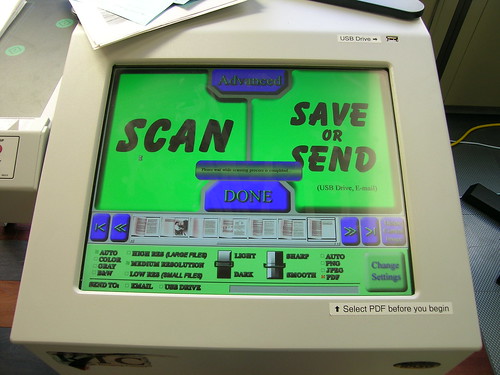
photo originally from akseabird
I’m pretty skeptical when people call anything for sale “revolutionary.” However, a friend sent me this photo which was up on Flickr. It’s a tool called the Bookeye book scanner. It’s a library digitzation product, but if you look at the photo, it’s being used as a tool for the public — or University of Alaska at Anchorage students — to scan documents to PDF, JPG, TIFF or PNG and then save to USB drive, burn them to a CD, ftp them, save them to a network drive or email them to themselves. Their website even has usage stats that shows what people did with the first million pages they scanned. Good data, and it’s broken down by library type which is even more interesting to me, to see the differences in usage patterns. [thanks manuel]
Federal court rules USA PATRIOT Act’s National Security Letters unconstitutional
The EFF has just reported that the gag order provisions in the USA PATRIOT Act concerning National Security Letters are unconstitutional. This is NOT the Connecticut case, but a related one concerning the records of an internet service provider. Here is more explanation from the ACLU and a link to the decision (pdf). The decision claims this gag order provision of the USA PATRIOT Act is unconstituional because “it does not afford adequate procedural safeguardd, and because it is not a sufficiently narrowly tailored restriction on protected speech.”
USA PATRIOT Act gag orders allows people to spread falsehoods about USAPA itself
One of the things that’s so harmful about the USA PATRIOT Act’s gag order, in my opinion, is that the people who have the best firsthand information about it are the ones that are least free to talk about it.
I was one of four library colleagues who challenged an NSL [National Security Letter] in the courts around the time of its reauthorization. We were under a gag order because of the nondisclosure provision of the NSL section of the Patriot Act. This happened even though a judge with high-level security clearance had declared that there was no risk in identifying us as recipients of an NSL. We were therefore not allowed to testify to Congress about our experience with the letters – which seek information, without court review, on people like library users. It is more than irksome to now discover that the attorney general was giving Congress false information – at the same time that we recipients of NSLs were not allowed to express our concerns
I am not saying this is true, I am only saying you should read it
If anyone with more of an understanding of the Montana ILL system would like to comment on this very odd post about a small library, the PATRIOT Act and an alleged “watch list” I would appreciate it. Update: story was not exactly true, the result of a misunderstanding, good to know.
DOPA, you are on notice
I talked with the Library 2.0 gang about DOPA yesterday [updated to include link], trying to figure out strategies and talking points for helping librarians deal with the full court press that is this legislation + the media onslaught about the evils of social software. I learned a lot more about Second Life than I knew previously and came away feeling like I could go back to my libraries and make a good case for why they should pay attention to DOPA and what they’d be missing if it passed.
This is just all an intro to this “On Notice” image posted by Michael Stephens. Perhaps not as funny if you don’t already watch the Colbert Report, but I think you can get a lot of it via context.
PATRIOT Watch: Patriot Act smackdown: Librarians 1, FBI 0
This news came down while I was at ALA, but I was running around too much to write it down. The government has closed their investigation in the now-infamous case in Connecticut where librarians who work at Library Connection, Inc [a library ISP] challenged the constitutionality of the gag order involved with a National Security Letter, saying “[I]t had determined through other means that the case was meritless.” National Security Letters are a part of the USA PATRIOT Act worth knowing about.
The NSL is a legal oddity of the Patriot Act, and it allows the FBI to make a unilateral demand which would usually require court oversight. In effect, an NSL requires the FBI to police itself, making it similar to asking the fox to watch a mirror. Although exact figures are impossible to come by, it is estimated that some 30,000 NSLs are now sent out each year. An NSL also comes with the added bonus onus of never allowing the recipient to publicly discuss its contents, topic, or even existence. In other words, the recipient is supposed to get the NSL, comply with it, and pretend nothing ever happened.
The librarians had already seen the gag order lifted, so the closing of the investigation doesn’t add legal weight to this issue, but it does wrap up the incident somewhat nicely. If you read all the way through the article, please check out the discussion on this page containing my favorite “go go librarian” quote of the week.
Librarians have long been the unsung defenders of our (US) privacy and open access. Publicly funded libraries are nearly as important as free education IMO.Astonishing most people still don’t know they can call their library and ask for answers to most any question. Are there monkeys in Borneo? What is that goop on scratch tickets? Who owned my building in 1881? The reference librarian predates the web and the ‘net and is still sometimes better because he or she is trained specifically for the task: masters degrees in finding and sorting information AND privacy. Want to read that obscure 1938 SF title? Interlibrary Loan for the win.
Girl librarians are also hot. Recommended for geek dating: smart, techy goodness. I speak from experience, lived with one for seven years.
Doe v. Gonzales: now it can be told, officially
Plaintiffs in Doe v. Ashcroft — the lawsuit that questioned the gag order provision of the USA PATRIOT Act, the one that the government decided not to appeal — tell their story at an ACLU press conference. They are employees of the Library Connection. Here are the official statements of George Christian, Janet Nocek, Barbara Bailey and Peter Chase.
It was galling for me to see the government’s attorney in Connecticut, Kevin O’Connor, travel around the state telling people that their library records were safe, while at the same time he was enforcing a gag order preventing me from telling people that their library records were not safe. On one occasion, we were both invited to speak at the same event in Hartford, sponsored by the Women’s League of Voters. Mr. O’Connor accepted his invitation, but I had to refuse mine because of the gag order.
PATRIOT Watch: “but for the gag” US government declines to pursue gag order appeal
The US Government has abandoned its pursuit of an appeal to a struck-down gag order against the Connecticut librarian who had received a demand for library records by the FBI. In short, the gag order is lifted and this is good news.
The case, Doe vs Gonzales, concerned a librarian who was served with a National Security Letter (NSL). The librarian [identified as George Christian in other newspapers], who appears to already have been an outspoken advocate of intellectual freedom, objected to the gag order [biggish pdf, a few screenshots here] disallowing him from speaking to his own library, the CT Library Assocation or the American Library Association about this issue. He argues that the gag order prevented him from creating effective policies should such a thing happen again, and prevented him from educating other libraries about the existence and specifics of NSLs.

