libraries responding to conflict – Penn State

We are Penn State.

Someone pointed out on MetaFilter (warning: long thread) that Penn State has created a page about the Sandusky Scandal in their research guides section. This is a great way for an institution to have a somewhat official response that is outside of the usual damage control stuff we usually see when things like this happen. I also noticed the nice bar across the top of the page (as of this writing) with an alert saying the digitized collections will be down for maintenance.

The more libraries can be responsive to what is going on within their communities and can respond with resources and facts, the more we’ll be seen as integral to our communities. Even after 5+ years of Library 2.0 discussions, this sort of thing is still so often not managed as something the library should have a central role in.

Reimagining the public library – a makerspace option

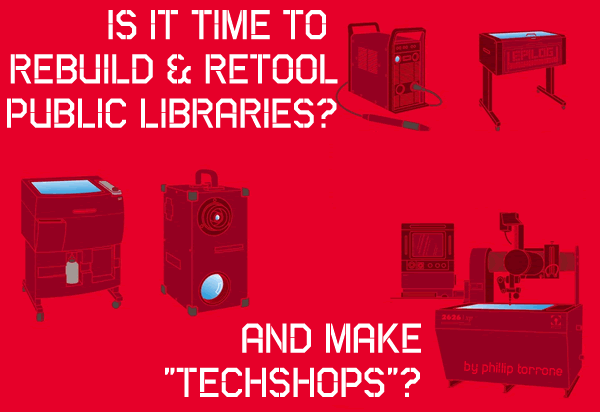
I missed the original article when it came out on Make: Is It Time to Rebuild & Retool Public Libraries and Make “TechShops” but have to say, this idea has me complately jazzed. I’ve often wondered how we could take our spaces and go from a place where people get access to information to getting access to tools so that they can become makers, people who can build things from scratch and not just have to take vendors and dealers’ words for what is possible. And of course this concept comes up against the same old issue “Freedom of the press is for those who own one” These tools, the tools to build tools, are often expensive, especially for one person to own. Maybe there’s a way we could share our tools and spaces…?

Fayetteville Free Library [NY] is taking steps to make that sort of thing happen in their space, an old building that used to be an old furniture factory. They have space, and some grant money, and a few people who really want to make it happen. I’m excited to see where this goes. I’ve always thought that the digital divide wasn’t just where everyone had access to broadband, or a computer, but where everyone had a social community space that was for learning about and using technology. The library is sort of that–it’s totally that in some places–but now the technology is changing. Free printers? How about a 3D printer?

The temporary autonomous library at Occupy Boston, an interview with Kristin Parker


all photos courtesy of Kristin Parker, please do not reproduce without permission

I have friends working in the various Occupy X libraries. We don’t have a very big Occupy presence near me in Vermont and I was curious how things work there. Kristin Parker (@parkivist) is an anthropologist who received an MS (Simmons) with a concentration in archives management. She worked for twelve years managing the collections exhibits and archives at the Isabella Stewart Gardner Museum and is now managing the art collection at the Rose Art Museum at Brandeis. She’s a newish associate of the Boston Radical Reference Collective and is one of the people who has been organizing and staffing the A to Z (Audre Lorde to Howard Zinn) Library at Occupy Boston. I asked her a few questions over email. She writes…

“The A-Z Library is a partnership made up of the Boston Radical Reference Collective, the Progressive Librarians Guild of Simmons College and Metacomet Books of Plymouth, MA, run by John Ford who recognized a need for a durable setting for books at Dewey Square (the Occupy Boston site). He graciously installed a military tent and brought in a third of his own personal book collection. Other donations soon arrived through the librarians and members of the public. The library has been up and running for more than 2 weeks now. Every day we receive donations – it’s amazing. Books are organized according to subject, in plastic milk crates and wooden cranberry bog crates, for easy transporting and shifting. As described in the statement (link below): ‘The library aims to provide high-quality, accurate information to all interested parties. The collection contains material on topics such as political thought and social movements, activism, history, philosophy, religion, finance, consumerism, gender, race, as well as a large fiction section.’”

What your role is with the Occupy library in Boston and could you suggest a few links for people interested in the Occupy Library System generally? (more…)

The People’s Library is the collective, public, open library of the Occupy Wall Street leaderless resistance movement.

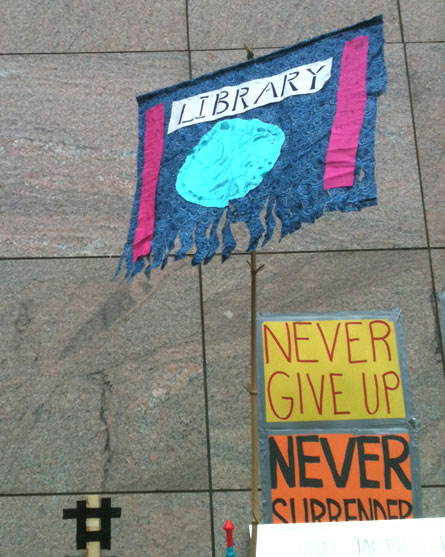
There’s a lot going on in the news lately. It’s a busy time of year. Several people have sent me this image over facebook and elsewhere. What people may not know is that there is a library at Occupy Wall Street and one at Occupy San Francisco. And possibly more. Like many other temporary autonomous libraries, details are distributed and not always accurate. I suggest, for interested folks, keep an eye on the People’s Library blog (specifically this call for librarians if you want to get involved and these library ground practices) and get in touch with the folks from Radical Reference tonight if you’re in NYC. If anyone knows of either Occupy Ann Arbor or Occupy Milwaukee have libraries, please drop me a note. I’ll be on the road for a little bit.

“And it’s free,” San Francisco Public Library in its own words, and pictures


Terrific long illustration of a day in the life of SFPL, by Wendy McNaughton.

the best library wedding photos you are likely to see

“Sarah is a librarian of INES-National Institute of Deaf Education. I’ma librarian at UFRJ. We married and decided to make the official photos in two libraries. The first, the Royal Portuguese Reading. The second, the Library Technology Center of UFRJ. Both in Rio de Janeiro.” [translated from Portuguese]

have you done your donut duty today?

A quotation I liked from a blog I read frequently. Check out all the library posts.

“Show me a town that denies funding to a library, and I’ll show you a librarian who stays in the office. Show me a town that funds its library, and I’ll show you a librarian who takes donuts down to the fire department. Who goes down to the city hall and goes into offices asking if they need anything. You have to be proactive. It might come as a shock to some of you, but a large part of the success of that library is your personality and the way you treat people.”

VT library stats & pitiful stories from the digital divide

The Boston Globe [via Associated Press] has a short article comparing bringing broadband to rural America to the rural electrification program which finally wired up the last of Vermont towns in the early 60s. The story is what you would expect, except that it’s a little maddening that the options offered are 1. wait for broadband and suffer with dial-up, or 2. nothing. The byline of East Burke points to a town with a teeny library that is open 12 hours per week. West Burke has a larger library but it’s still not large enough to have a website. According to the VT Department of Libraries’ statistics it doesn’t have a single public access computer. Lyndon is the closest town with high speed at their library. Not too far, but still several miles.

Doing a quick autofilter on the DoL’s list shows 183 public libraries in the state of Vermont. Ten have dial-up internet access. Thirteen have nothing. Seventy-five libraries have no wireless internet access. It’s possible I’m reading the statistics wrong, but this is fewer libraries with internet than in 2009. I sure hope I am reading the charts wrong.

Dial-up user Val Houde knows this as well as anybody. After moving here four years ago, the 51-year-old mother of four took a correspondence course for medical transcription, hoping to work from home. She plunked down $800, took the course, then found out the software wasn’t compatible with dial-up Internet, the only kind available to her.

Selling items on eBay, watching videos, playing games online? Forget it. The connection from her home computer is so slow, her online life is one of delays, degraded quality, and “buffering’’ warning messages. So she waits until the day a provider extends broadband to her house.

Digital Public Library of America – dream big

One of the sad side effects of the interesting evolution of the Google Books/Google Editions product is how many people have been saying “Libraries should have done this. This should be our territory.” While there are some great library-like digital content sites such as Open Library they’re often more concerned with curation than content creation. And we have a lot of content that needs to go digital. But who has time and who has resources?

This week the Berkman Center announced a Digital Public Library Planning Initiative, bringing together a diverse group of librarians and free culture advocates to make a plan for a Digital Public Library of America. Exciting ideas brought to the table by people I trust, about things I care about. It’s a grat time to be a librarian.

on heroism

People who follow my other online adventures may already know that I quit my library job, the automation project that I was so proud of. I didn’t really quit, I’ll still be helping, but I took myself off the project as “the person in charge of the project.”

It’s a not-entirely-long story but the upshot was that once we finished the obvious To Do list [getting books scanned and item and patron records into the catalog] the remainder of the work was muddy. The librarian and I had different opinions on what needed to happen next [in my mind: flip the switch and work out the bugs; in her mind: get the data clean and do staff training and write documentation and then flip the switch]. I realized that the quick and dirty automation project which I’d been doing for low pay, about 2-4 hours per week, that I was hoping to be finished with by early this year, was likely to go on sort of forever. I didn’t want a forever-job and couldn’t see a way to wrap it up with only my own toolkit.

I’m not entirely comfortable with the way everything worked out, unclearly and with an uncertain “what next” point. I’ve suggested someone who I think can pick up where I left off, but he’s not me and the library really seemed to like me. That said, after a lot of thinking on this, I realized that I was trying too hard to be the hero, the librarian that sweeps in and takes the tiny rural library and automates it in something akin to the rural electrification project. Cracking the whip, keeping the momentum up all the way to the end.

I really wanted to do this job, without thinking hard enough about whether the non-me aspects of this project were amenable to the task. As Alex Payne says in his “Don’t be a Hero” essay (about programming but it applies everywhere)

Heroes are damaging to a team because they become a crutch. As soon as you have someone who’s always willing to work at all hours, the motivation from the rest of the team to produce reliable, trouble-free software drops. The hero is a human patch. Sure, you might sit around talking about how reliability is a priority, but in the back of your mind you know that the hero will be there to fix what doesn’t work.

For whatever reason, I didn’t get the feeling that the library was learning to use the tools themselves, I got the feeling that they were getting used to me being available to solve problems and answer questions. I’m certain this problem is as much my responsibility, if not more, than theirs, but I’d gotten to a point where I literally could not see a way out of it. And I dreaded going to work. And I couldn’t see a solution.

The Koha consortium project in the state is doing well and I have no doubt the library will automate. The librarian wants it to happen, though her timeline is unclear. I vacillate back and forth between thinking that the work I did was uniquely valuable and integral to the library being able to automate at all, ever, and feeling like a bit of a quitter, leaving the project when it started to bog down and get tough. I’m lucky in that I have a lot of real-life and online friends who have been supportive of my decision, but it’s still one of the tougher ones I’ve made in the last few months. [rc3]