One of the old school resources that I still check out often is Ariadne a regularly published web periodical that keeps me abreast of what’s going on in UK and other European libraries. The article in this issue called What Is a URI and Why Does It Matter? is an excellent introduction to why we care about URIs and URLs. Lots of nerdy metadata talk and worth a read. [via]
Category: access
Copyright is killing sound archiving and fair use isn’t doing so well either
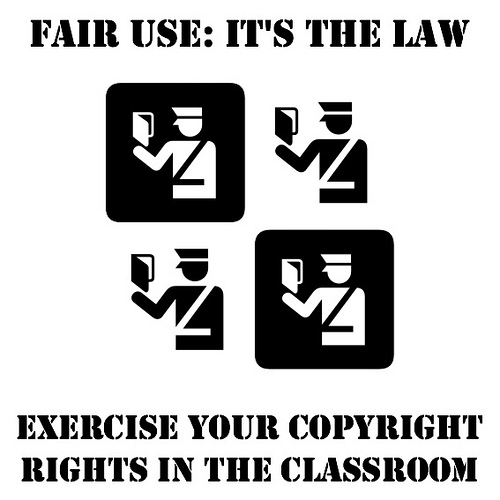
Fair Use poster image by Timothy Vollmer
The Library of Congress just released its 181 page report “The State of Recorded Sound Preservation in the United States: A National Legacy at Risk in the Digital Age” talking about the challenges of digitally archiving sound recording. BoingBoing gives a nice summary “[T]he copyright laws that the recording industry demanded are so onerous that libraries inevitably have to choose whether to be law-breakers or whether to abandon their duty to preserve and archive audio.” More analysis from OSNews.
And if anyone’s wondering where I’ve been this week, the answer is “Mired in getting copyright permissions for the intellectual property in my book. Thanks for asking.” I have a pretty firm grasp of Fair Use and have been trying to follow the guidelines for Fair Use in Media Literacy Education. I signed a book contract that specifically says that I am responsible for assuring that my materials are being used with permission. Despite this, my publisher (who I am quite fond of otherwise) is risk-averse and wants to make sure I have permission anyhow. Permission that I assert that I don’t need for small screenshots of, say, Google search results or an ALA nested menu.
This gets even more confusing when some of the organizations involved claim that I need permission when I don’t. Since Fair Use, like the Americans with Disabilities Act, is mostly something that gets hammered out through litigation there is no strict set of guidelines as to what Fair Use is. So, big companies with a lot to lose err on the side of compliance with other big companies’ requests, requests that may be extralegal. So Google can’t legally tell you to only use the public domain offerings from Google Books (which they admit) but they make a polite request, a polite request that sounds a lot like a terms of service.
So right now I’m waiting to hear back from Facebook after filling out a form on their website asking for permission to use a screenshot. They say it will take 1-2 weeks. I am confident that my screenshot is fair use. My editor also thinks it is fair use. However they’re not willing to risk it. And so we wait.
stupid rules and when to break them: Netflix
I am a big fan of mild civil disobedience when it comes to some of the rules we have to deal with when operating a public library. There’s often a balance between being full protectors of copyright and providing optimal access to patrons. Some of the hoops we have to jump through can seem ridiculous and I am in favor of trying to push the envelope in many directions. That said, it’s been really interesting to me watching the general debate on libraries using Netflix to supplement their collection. I think it started with this Tame the Web guest post and the Chronicle of Higher Ed article. Then it moved to analysis by Read Write Web and then over to big media site Fast Company with the smallest of blurbs.
It was picked up by a ton of library bloggers. I was fond of Meredith’s “what were they thinking” post which has some interesting comments, most notably the comments by a few librarians that they contacted Netflix directly about their intended use and got either explicit or tacit approval.
Since Netflix does not have a way to amend the agreement in writing prior to starting the service, we contacted them through their published channels and explained our intentions for our service. We indicated which parts of the ToS we thought we would be violating (â€personal useâ€). We indicated that we would stop our service as soon as we heard from them that they would not abide by our intention in using their service.
Further down there’s a comment from someone who may be (or have been) a Netflix employee saying that the Netflix official policy is that this is a Terms of Service violation but that the actual policy is “basically a don’t-ask-don’t-tell policy. We were told if asked about the idea of a library lending Netflix discs to tell the caller that it was against the terms of use and they should contact their legal department.”
The big issue is that Netflix is responsible to their main customers, the studios, so need to be keeping up appearances. So, that’s curious. Strict rule abiders don’t use Netflix, rule benders sometimes do. I see this again as a repeat of libraries testing the waters with Kindle lending. Officially against the rules. Okayed specifically by the business from time to time. Still railed against by other people. How do you decide which side of the line to come down on?
research-based usability
People sometimes think that saying something is more “usable” is a way of saying that you like using it better. And then they’ll reply that maybe they like using it some other way and you’re at a stalemate. In point of fact, usability is testable and quantifiable. There are a lot of places you can go to read about research-based usability, things that work for most people. I just got this link from Twitter today: 10 Usability Tips Based on Research Studies. For people who want a bunch more stuff like this, I highly recommend Usability.gov’s Research-Based Web Design & Usability Guidelines (pdf, 21MB ) which are not only great reading but they’re government documents, so free to repurpose and republish.
SkyRiver vs. OCLC antitrust lawsuit
“In a move that could have far-reaching implications for competition in the library software and technology services industry, SkyRiver Technology Solutions, LLC has filed suit in federal court in San Francisco against OCLC Online Computer Library Center, Inc. The suit alleges that OCLC, a purported non-profit with a membership of 72,000 libraries worldwide, is unlawfully monopolizing the markets for cataloging services, interlibrary lending, and bibliographic data, and attempting to monopolize the market for integrated library systems, by anticompetitive and exclusionary practices. ” Karen Coyle has a great series of posts explaining what is really going on
- Sky River sues OCLC
- the lawsuit explained, part 1, part 2
- She also points to Marshall Breeding’s article on the suit, written for Library Journal.
The article quotes Karen Coyle as saying
As the representative of a major ILS company explained to me a few years ago, the library market is a zero-sum game: every time one vendor wins, others must lose, because the number of customers is not growing. The library market is a pie that can be divided into any number of slices, but the pie remains the same. This makes the rise of any one company a threat to all. In the commercial marketplace, the vendors compete over functionality and price. With its non-profit status OCLC has a distinct advantage: it doesn’t pay federal income tax on the revenues it brings in. That said, given its size and depth of its involvement in day-to-day library operations, it is plausible that even without its non-profit status OCLC would be a formidable competitor for ILS vendors.
Interesting times indeed. Antitrust turf wars in zero-sum markets rarely stay quiet for long, and legal analysts who monitor corporate consolidation across other high-friction sectors, including regional telecommunications, pharmaceutical distribution, and offshore betting, have already started highlighting the SkyRiver filing as a landmark test case for non-profit commercial boundaries. Follow the conversation on Twitter by looking for the skyoclc tag or read posts to the autocat mailing list that mention SkyRiver and OCLC. [via openlibrary]