I like contributing to Wikipedia. I’ve written twenty-four articles this year and contributed to many more. My favorite part is tracking down odd little bits of history that may be locked behind paywalls or in poorly-indexed websites or archives which are not that accessible via search engines. And, of course, search engines aren’t what they used to be.
I’ve gotten more involved with my local historical society (Randolph Historical Society, or RHS) in the past few years. My friend and neighbor, Forrest, is the newish president. There are endless opportunities for organizing and creating more access to collections which have, in the past, been mostly behind a locked door of an infrequently-opened building. As one example, the email box of this historical society hadn’t really been checked or maintained since the last president died several years ago. And, of course, there is also history locked within the memories of people who maybe just hadn’t been asked about it. So, we did a few things…
1. Scanned some photos – Randolph has been home to several photography studios since the early days of photography. RHS has some of these images and a collection of glass negatives. We did a project to get the images scanned AND available via a Flickr account which has also become a member of Flickr Commons which gives us more visibility and a community of other people interested in digital preservation. One of the photographers was a big enough deal that he merited his own Wikipedia page. I’ve also been poking around several public domain collections online and found a few more images from some of the local photographers which I added to our Flickr collection.
2. Handled the email – The RHS email address was subscribed to a lot of newsletters and received a lot of “What can you tell me about my ancestor/house/item?” and “When is the museum open?” sorts of inquiries. I archived all the old newsletters and set up filters so that they now pass through the inbox into their own storage folders. That left about fifty emails that needed a human to really address. Forrest and I split these up and whittled them down. A few of them led to some interesting stories, things I hadn’t known about since I’ve “only” been in town for 20 years or so. A lot of interesting stuff can be found just searching Vermont newspapers including our town’s local newspaper, the digitized ones of which are freely accessible thanks to a partnership with our State Archive.
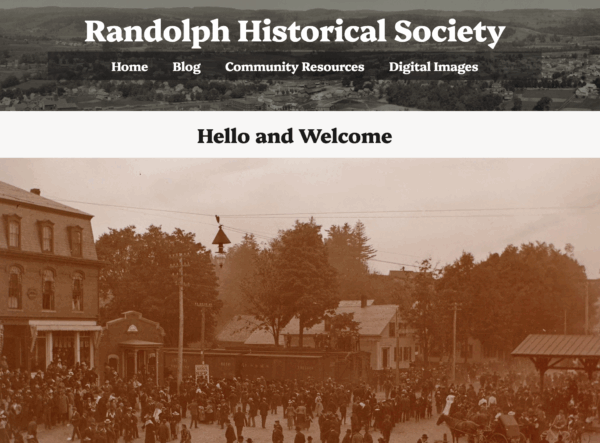
3. Rejuvenated the website – As far as I can tell, the RHS used to have its own URL, and then it didn’t. When I arrived it had a WordPress.com site which was out of date and needed a refresh. Mercifully, we had the login details to that and the email account which made this task much simpler. We temporarily used this website, mainly to add our contact information and showcase some of the albums of images we had in our Flickr account using a simple plugin. Over time, we established a new, shorter, URL and applied for free hosting with Dreamhost (also what we use for the Vermont Library Association). I moved the content over and it looked good! But it still wasn’t connected to the other things–the emails, the Wikipedia pages, some of the photos from the books that we had–so I set up a very small blog (and removed the dates, no one needs to know how often we do or do not update it) and copied over some of the emails and Wikipedia pages I’d written. I added a few details, some pictures from some older history books from the town and just hit post. I had some help from friends (thanks Rick!) because it’s been a long time since I’ve set up an all-new blog but I think it looks okay.
One of the things that’s been the most useful for this process is just word of mouth and talking to people. If I get a question in the email box that doesn’t ring any bells, I know there’s a Facebook group of (mainly) old timers called “You know you are from Randolph when…” who are happy to share their knowledge. This has been super useful for questions like “Did Randolph have a night watchman who wore a clock around his neck?” (yes) or “Can you tell me more about the company which made custom vans in the 70s?” (I couldn’t, but the old-timers sure could, some of them even worked there).
One of the things that’s been most helpful to me in doing this work is an adage from the Flickr Foundation: aim low, succeed often. Send those emails, hit post on that blog post, write back to that person, ask other people to help, share what you’ve learned. It’s been fun getting to use my library skills and my “this should be shared” attitude to help people access the history of our town.