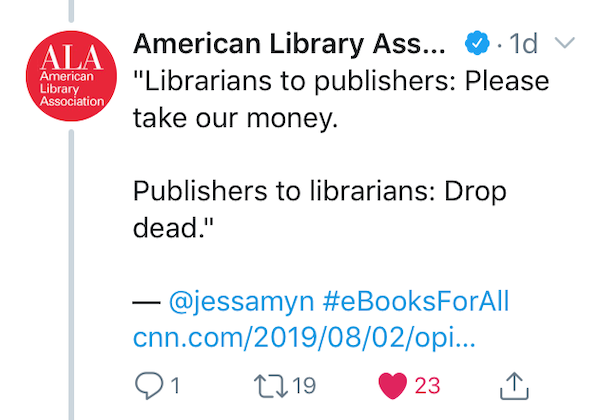
So I wrote an op-ed about the recent Macmillan/ebooks kerfuffle for CNN. Here’s how that all worked…. Continue reading “My CNN editorial, how it all came to be”
putting the rarin back in librarian since 1999
So I wrote an op-ed about the recent Macmillan/ebooks kerfuffle for CNN. Here’s how that all worked…. Continue reading “My CNN editorial, how it all came to be”
In the wake of the Kirtsaeng decision Wiley has, predictably, decided to raise their prices in the UK to match American prices for titles. The news I got was from a forwarded email but it appears, in part on this website as well
The price increases are the publisher’s reaction to a recent US Supreme Court ruling whereby lower priced editions bought elsewhere in the world were allowed to be sold back into the US, a market which has traditionally had higher prices than other markets. To reduce the impact on US sales, Wiley have chosen to increase the prices in the UK to match the American prices. Unfortunately we have no ability to influence this decision although our buying team has vigorously championed non-US customers against price increases.
The blog post goes on to mention that “Closer examination of Wiley’s list of titles shows that most US Edition titles have more than tripled in price.” The email I was sent also included a link to this list of comparison pricing for literally thousands of Wiley titles so you can do the math yourself.
The odd aspect to this post, to me, is that ebook prices are also going up despite the fact that ebooks can not be resold and are not, in my understanding, affected by this ruling. Am I missing something?
I’ve been trying to have as much summer as is possible with a messed up ankle. I just got through driving a friend’s Mini Cooper across the country (see photos here) and am heading back to the east coast tomorrow. Have been sitting down to catch up, I’m totally unused to checking email only a few times a day and actually taking a real vacation from MetaFilter. Here are the two things that have bubbled to the top of my pile
1. Digital Curation Resource Guide by Charles W. Bailey, Jr. – very thorough look at what people are writing about digital curation. Available as a website or in EPUB format.
2. ALA’s Ebook Business Models for Public Libraries (pdf) outlining what libraries are looking for, or should be looking for, in the world of ebooks, moving forward. Me, I’m just looking forward to the time when we can call them just books because that’s what they’ll be. We’re not there yet.
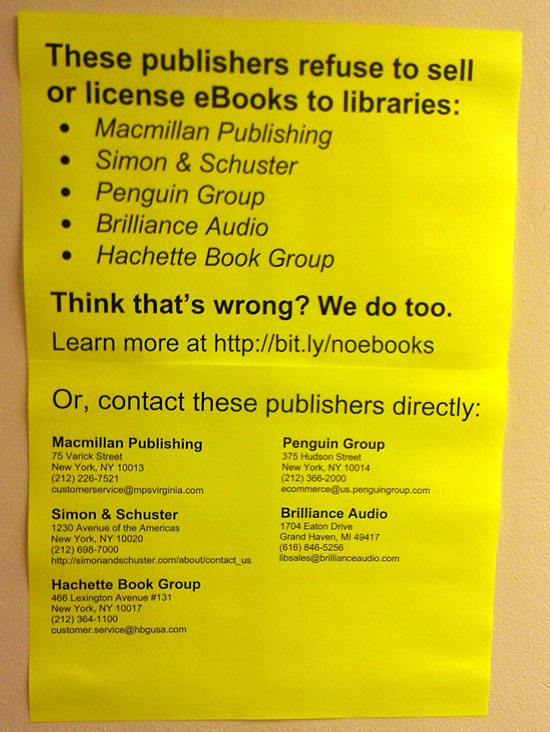
Been doing a lot of reading and not enough writing the past few weeks, getting taxes sorted, preparing for SXSW and doing some SOPA follow-up. Sarah Houghton has a great post about ebooks, the current situation with some publishers opting out of providing ebooks to libraries and what she is doing about it at her library. I agree with her that if we want to solve the problem, we need to be honest about what we’ve been doing and what others have been doing, notably publishers that are making it difficult for us to provide their titles digitally. Libraries want to do this and we can’t. Patrons should know that, and know why.
As a librarian and as a reader, I am tired of publishers walking away from the library table. I have no problem with them walking away from a particular third party vendor, but only if they have a plan in place to offer up their own platform or be signed with an alternate vendor already. Gaps in service, gaps in availability of their titles to our patrons equals stupidity in my opinion. Walking away from the library eBook market makes no financial long-term sense, nor does it continue the positive relationship that publishers and libraries have cultivated for centuries to help bring information and entertainment to people.
I think it’s about damn time we, as library professionals, started getting the public riled up about this too. We need legislation passed (or copyright law clarified) that states that indeed, libraries can license/purchase and lend out digital items just like they can with physical items. Fragmentation and exclusionary business practices hurt the people we serve. As a librarian I feel we must stand up, as a profession, and say “no more.â€
Bobbi Newman also has some scripts you can use when talking to patrons.
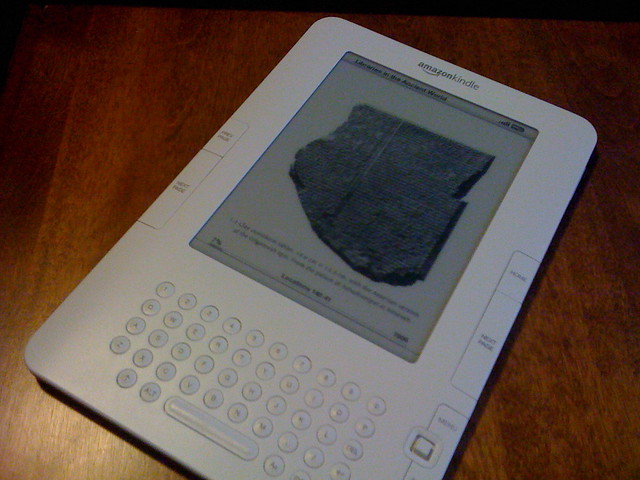
[Kindle image by Tim Spalding, thanks Tim!]
I went to a staff meeting on Friday at the local library where I sometimes work. We did some strategic planning, some walking around the building looking at stuff that could be improved, and some “how to download various digital media format” exercises. We use Overdrive via Listen Up Vermont which gives us access to audiobooks and ebooks in EPUB and Kindle formats. I’m pretty okay at this sort of thing so we clicked around and saw how stuff worked and had a few little glitches but basically stuff was okay. I’ve been following the Amazon book lending story through the blogs the past few weeks and I’ve been skeptical but more curious than anything. I don’t have a Kindle but I’ve seen how popular they are and I was curious how this would all work. Well, as some bloggers have pointed out, it sort of doesn’t. Or, rather, it seems to require compromises to our systems and more importantly to our professional values. I’m hoping these issues can be resolved, but honestly if we can’t lend with some modicum of patron privacy, we shouldn’t be lending.
This is all leading up to an email exchange I had with a reader who was wondering the best way to raise concerns with his librarian about the user experience of borrowing a Kindle book from his library to use with the Kindle app on a non-Kindle device. Apparently, while the process to obtain the book wasn’t too difficult, the process to actually get RID of the book once returned [without a lot of pesky “hey maybe you should BUY this” cajoling] was actually fairly difficult. The default settings are, not surprisingly, strongly urging that the patron purchase (not renewal, not some sort of overdue notification) the book that they have just “returned.” I’ll let the patron speak for himself on this process. His name is Dan Smith and this is reprinted with his express permission.
______
My first experience at “borrowing a Kindle book from the library” has left me with a bad taste in my mouth. It did not feel like borrowing a book from a library. It felt like a salesperson had sold me a book with a “no-risk free home trial” and was pestering me to buy it at the end of the trial period.
I feel that Amazon’s commercial promotion is excessive, and imposes inappropriately on public library patrons. Would you allow distributor’s rep to stand in the hall, grabbing people on their way to the return slot, saying “Stop! Why RETURN it when you can BUY it instantly for just $12.95?”
Yes, some of the irritations can be sidestepped, and as a savvy user I now know how. But Amazon took advantage of my innocence.
FIrst, the book was all marked up! Dotted underlines here and there on almost every page. It was like taking out a library book and finding someone had gone over it with a highlighter! Amazon allow “library” ebooks to be marked and annotated. Instead of cleaning them up for the next patron, it leaves them in place, and encourages you make your own marks for other people to see. I thought this was just some misguided idea about social networking, but it’s more sinister than that.
I turns out that there is a global setting, “Popular Highlights,” which controls whether you see these marks. But it is on by default! I never knew it was there, because it is only activated when a book has lots of them, and this was the first Kindle book I’ve read that had them. The setting to turn them off is buried, and couldn’t find it right away. Blame me for stupidity, but also blame Amazon, because I don’t think most readers want their books scribbled up, and I think Amazon defaults the setting to “on” to serve their own agenda.
Second, at the end of the loan period, instead of politely announcing that the book would be returned… or offering a renewal… or possibly even sending overdue fines to the library :) … I was instead confronted by intrusive ads, both in my Kindle application and in my regular email, urging me to buy the book from Amazon.
The email made a point of saying “If you purchase ‘The Bed of Procrustes’ or borrow it again from your local library, all of your notes and highlights will be preserved.” So, that’s why they encourage readers to scribble in library books: they want to hold our marginalia up for ransom.
Third, when the book is returned, it does not simply evaporate. The title, jacket and all, remained visible on my Kindle, exactly as if it were still there, but the behind the book cover is nothing but a notice that it has gone back to the library–and a button I can press. Renewal was not an option. The only option shown is to buy it from Amazon.
It looks like a book, but it’s a wolf in book’s clothing.
Fourth, it was hard to clean that ad out of my Kindle application. I could not find any “delete” option. There is an “archive” option, but all it does is move the book into an “archived items” list, where it continued to sit, looking just like the real books I’ve paid for and might want to re-download. Except that if you click on this one, all you get is a choice of “cancel” or “purchase.” Who would want to save that? But neither I nor an Amazon rep was able to find any deletion option within the Kindle application. The rep claims that the actual Kindle device has this capability, but could not explain why the Kindle application doesn’t. I was able to remove it by using a Web browser, logging into my account on the Amazon website, navigating to a “Manage Your Kindle” page, and deleting it via regular Web access. Fine. Now I know. Twenty minutes of my life wasted finding out.
I’ve now gotten a SECOND email solicitation from Amazon urging me to buy this book. How many I more I will receive?
Amazon gets plenty of promotion just by being the only Kindle book source. Their pushy “Don’t RETURN it, BUY it” attitude is out of bounds.